Posts Tagged ‘Best Restaurants’

Sitka & Spruce: Seattle

Posted 11 Feb 2012 — by S.E.
Category Fine Dining

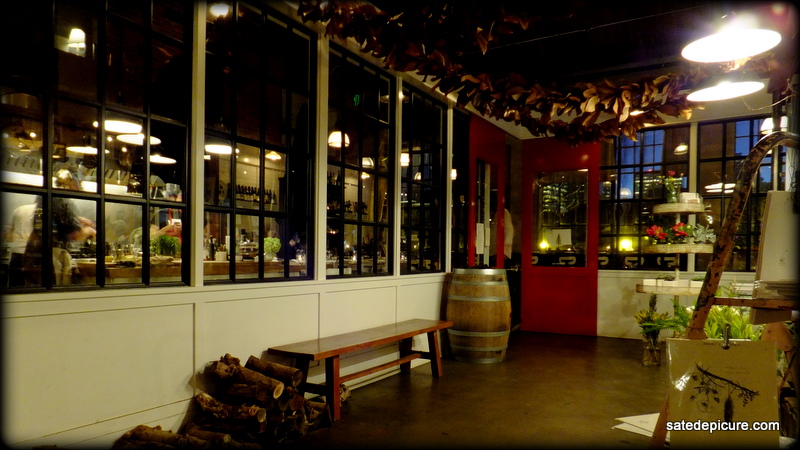
I make one last stop on my Seattle tour at chef Matthew Dillon‘s Sitka and Spruce back in the Melrose Marketplace. It’s rainy and cold again and each fat drop falling from the sky cuts across my face. Stomping the water and weather off my feet, I head inside past the specialty butcher, the wine shop and bar, and flower stand. Tucked into the rear corner is Sitka and Spruce; separated from the rest of the market by a partition composed of large windows and white framing. It’s warm and bright in here. Although inside the market, I am outside the restaurant looking in through the large eight over eight windows while I wait for the doors to open. Staring at the blur of cooks prepping and planning on the other side has me captivated with memories of my line-cook days in a prior life. Lost in thought, it is forever in a second before the double red doors slide open and I return to the moment and enter.

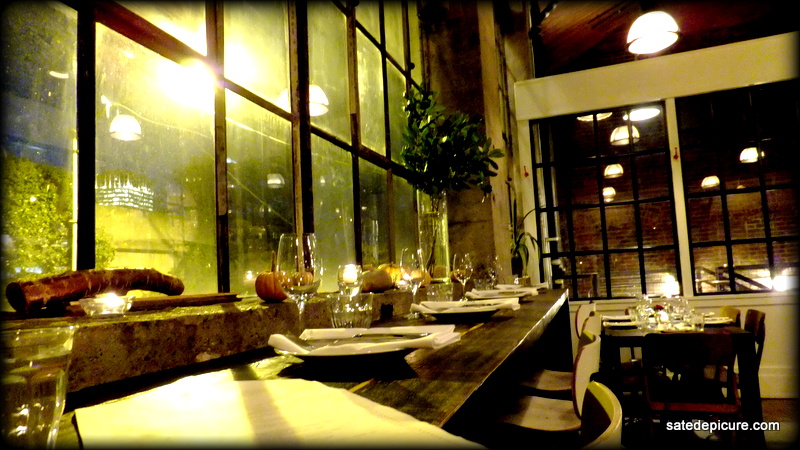
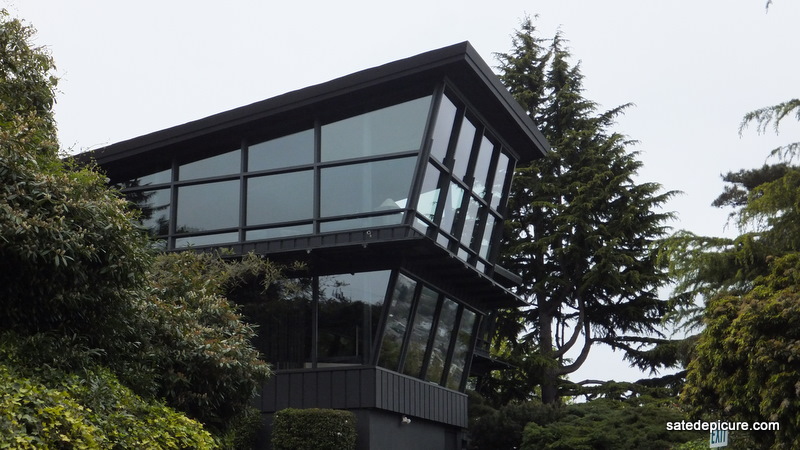
Inside and alone, I sit at the long hewn wooden counter of single stools running along the wall under a bank of exterior windows. Suddenly it feels overcast in here, with dim street lights casting a glow into the room, painted in neutral colors. Staring out through the glass while I wait for a menu, I notice that the window is old and probably original to the building. The glass is dusty and slightly fogged over and in places caulking has come undone. The rest of the restaurant space is mostly renovated, efficiently designed, otherwise spotless but with a planned historical texture and character. With high ceilings made of exposed timber and a large open kitchen with fireplace, it is clear that someone chose to respect and enhance this space rather than blow it to pieces. Overcast is the wrong word, the restaurant is subdued, the intensity retro but not fake, the vibe and the people smart, environmentally green, respectful and happy in that “we have a great restaurant and we know it, work our asses off but never take it for granted” sort of way.

The menu arrives, she takes a minute to talk with me and figure me out “try the fresh anchovies from Oregon” she says remaining suspicious because I have a camera. “Do you like liver mousse?” Always I say especially when properly prepared and yours is served with sherried chanterelle mushrooms. Liver, chanterelles and sherry are flavors matched in heaven. Send one of those out too. “We have a small plate of buckwheat crepes with salted ham and endive, the endive is caramelized and wilted over the crepe.” Yes please. She sees that I am fair game “how about the local halibut with sauerkraut?” How about it I offer.

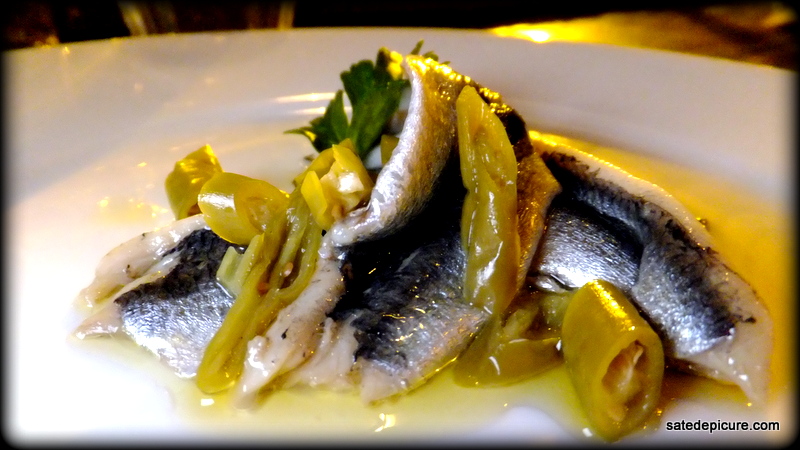
Sometimes I don’t even need to see the food to know that a restaurant is good. This is that kind of place. She could have sold me the entire menu if not for a limited budget and appetite, curious as I am. The fresh anchovies arrive first, five gorgeous fillets glistening with olive oil and fresh lemon. Medium thick slices of pickled green chili pepper as round as a pencil and a sprig of parsley provide shades of green to compliment the silvery white fish. These aren’t salted and cured anchovies they are beautifully fresh, light and sweet fillets with perfect seasoning and spice; I could eat a dozen of them.

Marinated Anchovies from the Oregon Coast with Pickled Chili Pepper

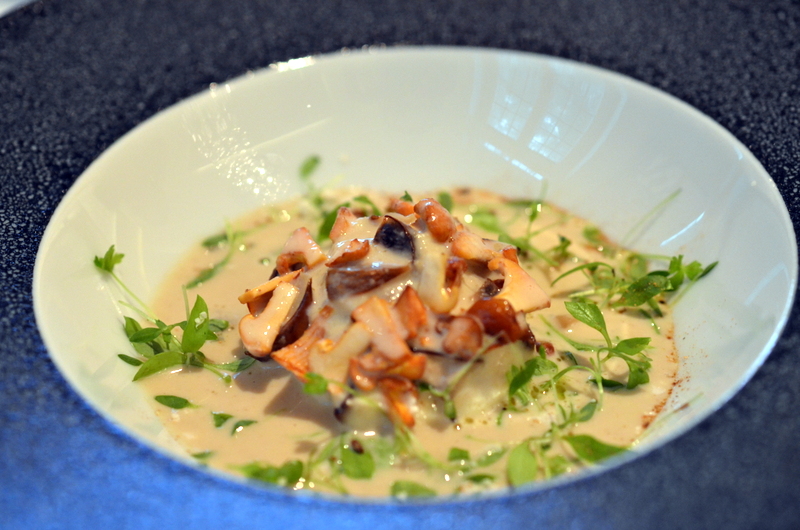
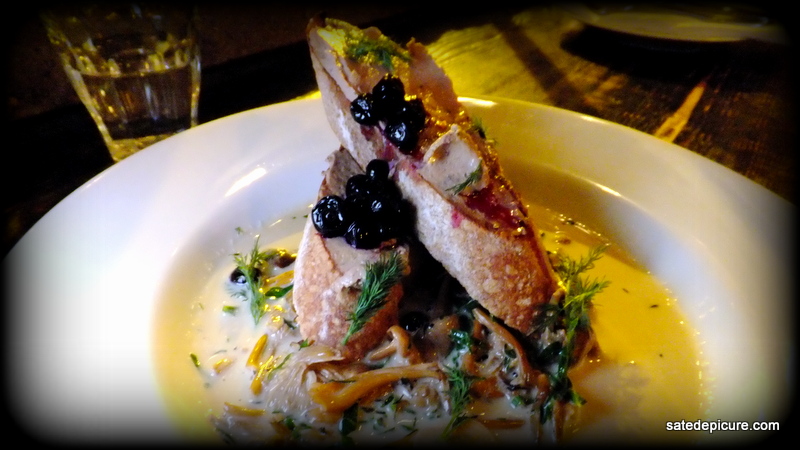
A few more sips of sauvignon blanc and the liver mousse arrives. A thin coating of mousse tops lightly toasted slices of French bread and tart little huckleberries.  Sautéed chanterelles are layered on a sherry cream reduction with fresh herbs including dill and tarragon. These flavors are meant to go together and I sop up the mushrooms and sauce with the French bread slices.

 Cooked in Sherry with Huckleberries and Liver Mousse

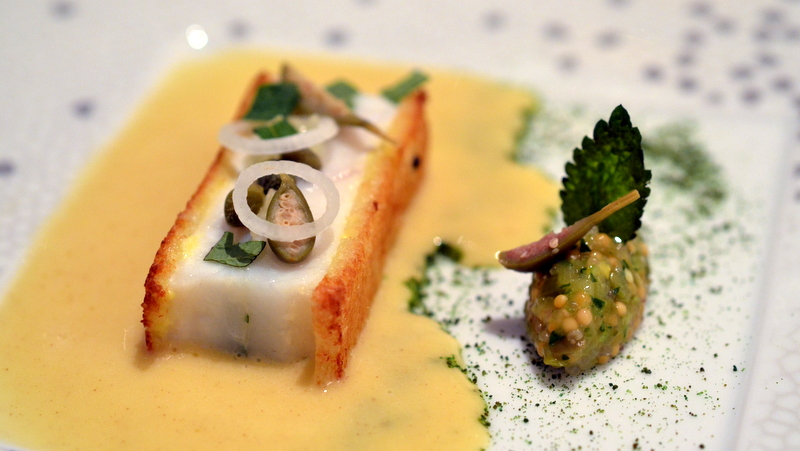
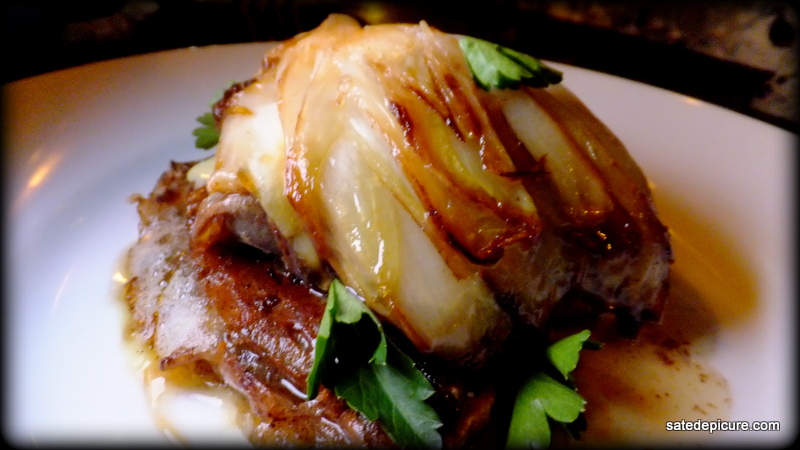
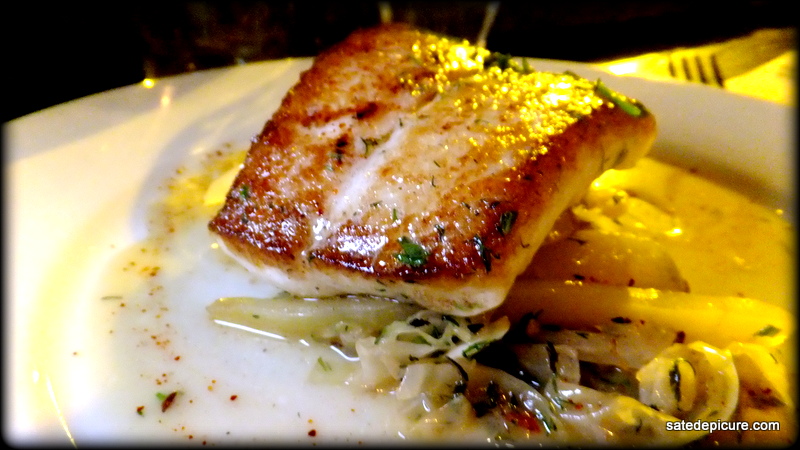
Now I am overly distracted by the food and, when the crepes come, start to eat the dish before taking a photo. Catching myself, I pause, click a quick shot and dig in. The endive is caramelized just enough to wilt and sweeten, the bitterness having cooked out. There’s more fat in this dish providing richness and depth. The portion is perfect. Then the halibut with sauerkraut and white carrots arrives. When in Seattle I usually order Sablefish with halibut a close second. Tonight Sablefish wasn’t on the menu so I didn’t think twice about the halibut. Seared then steamed gently, it arrives perfectly cooked albeit lacking contrast and color other than the golden brown top of the fish. However, the dish is a study of elegant simplicity pared with a level of craftsmanship worthy of praise. Each course arrives in perfect 12 minute intervals. In less than an hour I am sated and comfortably so.

Buckwheat Crepes with Salted Ham, Onion, and Endives

I will return to Sitka and Spruce, it is one of those restaurants that has an identity, simplicity, confidence, and level of execution that comforts and pleases in a manner similar to Avec in Chicago and No. 9 Park in Boston. More important, Sitka and Spruce is a reflection of Seattle itself in style and character and this too makes me want to come back to the city and to this place.

Seared and Steamed Pacific Halibut with White Carrots and Sauerkraut

Sitka & Spruce

531 Melrose Ave.  Suite 6, Seattle, WA 98122

(206) 324-0662

Canlis Restaurant, Seattle

Posted 29 Jul 2011 — by S.E.
Category Fine Dining

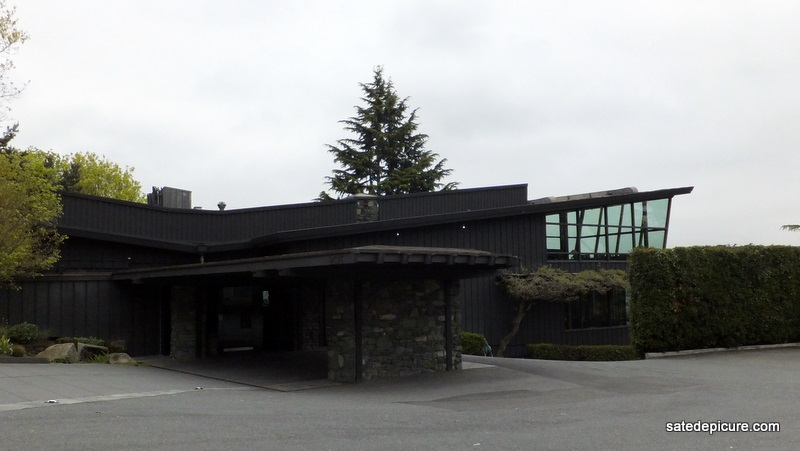
It’s nearing sunset on a crystal clear blue-sky day in Seattle and I need to relax.  My meetings required traversing the city at  morning and evening rush hour and a good part of the day was wasted in traffic. I hate traffic. Now that’s all behind me and I am on my way to dinner. After a few wrong turns (as usual) I find Canlis restaurant and pull up to the front entrance. The building is a dark brown wooden gem with a modern mid-20th century “Frank Lloyd Wright meets the North West” aesthetic including large exterior walls of pitched glass facing Lake Union down below. I step out of the car and the valet opens the double glass door entrance for me and takes my car keys. Before I can turn around, he is gone with my car and I walk away wondering why he didn’t provide a claim check prior to departing. Shrugging it off, I head for reception to check in and after a very short wait find myself sitting in the lower dining room facing the windows and a magnificent view.

Peter Canlis founded his namesake restaurant 1950 when he was 69 years old after a career in the hospitality industry that spanned the globe from Greece to Cairo to New York, Hawaii and, ultimately, Seattle. According to family history Peter is credited with being an expert restaurateur and innovator and was one of the first in the country to employ team-style service n the dining room. He also understood how to create a niche for the restaurant and, in addition to excellence in the kitchen, employed  kimono-clad waitresses in his dining room; a likely influence that travelled back with him from his stint in Hawaii. Stunning photos of these waitresses serving the likes of Dean Martin, Sammy Davis Junior and Frank Sinatra line the wall along the back stairwell to the restaurant. Peter was a genius and Canlis was a definite “A-List” restaurant from the very beginning.

Incredible as Peter’s story is the leadership displayed by third generation owners Mark and Brian Canlis (Peter’s grandsons) is equally impressive. Talent is woven into the genetic fiber of this family. After taking the restaurant over from their parents (Chris and Alice) in 2005 Mark and Brian came to a point where they had to either sell the restaurant or double down, go all-in, and reinvest in the restaurant to bring it back to its former glory. The boys had a great opportunity to cash out and sell to a developer who planned to construct condominiums. They didn’t sell out.

Like many restaurants in the U.S. that have more than 20 years of history, Canlis’ food and service had gradually diverged from contemporary preferences and, from what I hear, the restaurant had become a bit threadbare and dated. What makes this story so different and so inspiring is that Brian and Mark took on the challenge of redirecting the restaurant and never looked back. Both displayed the courage and leadership required to wipe their approach to food and service clean and start over, something that scarcely happens in restaurants like theirs. Darwin’s theory of evolution suggests that the most adaptable (fittest) organisms survive the test of time and adapt the restaurant did!

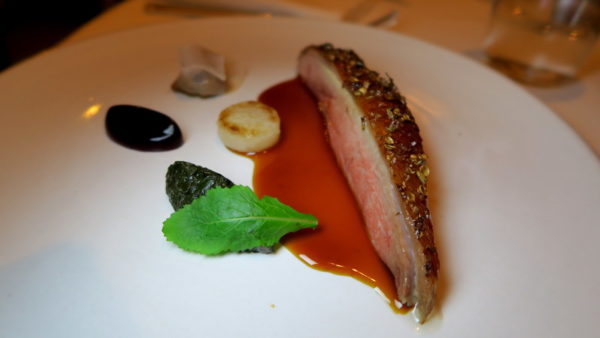
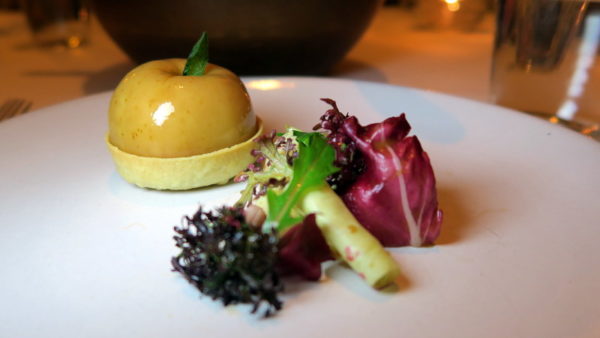
This is where Chef Jason Franey comes in. A friend at Eleven Madison Park in New York raved about Franey, her former colleague who served as executive sous chef at the restaurant prior to taking the helm at Canlis. She suggested that I visit Franey and have the chef’s tasting menu. It was excellent advice. Franey joined Canlis in 2009 after Brain and Mark conducted a national search for what would be the fifth executive chef in the restaurants history. He took on the role of executive chef with full confidence and commitment and hasn’t looked back. His kitchen, much like Eleven Madison Park, works like a Swiss watch with an ergonomic design (Brian and Mark rebuilt the kitchen for Franey) and sequence of production nothing short of perfect. I stood to the side in the kitchen as Franey seamlessly organized and expedited each order while carrying on a conversation with me. To say he is comfortable in this kitchen is an understatement. Franey is of medium height and build, wide around the shoulders, and radiates pure confidence. He is a culinary athlete in the major leagues just about to hit the top of his game. Delighted, I head back to the dining room.

Soaking it in, I begin to relax as the setting sun casts an orange glow through the long row of windows. Several smartly dressed couples from Seattle’s young, urban and wealthy community hold hands and chat while leisurely sipping cocktails and sampling Franey’s fare. In the distance I spot a single-engine sea-plane taking off from Lake Union below. The plane makes a wide circle around the lake gradually gaining altitude until it floats level with the restaurant, a bright flash of yellow paint passing between the tall evergreens just outside the window. My amuse bouche magically appears in front of me (I didn’t even notice the server who brought it) and I forget the day, the stress, the traffic, the early departure in the morning and feel wrapped in comfort and care. Canlis has grabbed hold of me and I feel a depth of professional and authentic hospitality rare in the world today.

I have no way of gauging the quality of today’s Canlis compared with the original operated by Peter in the 1950’s but I bet Peter would be delighted and the Canlis of today could very well be the best yet. As my time at Canlis comes to an end I find my car waiting right outside the front entrance. Peter Canlis believed in anticipating the needs of his guests and surprising them by staying one step ahead with service. Having your car ready when you exit is one of the traditions preserved along with many others – no claim check required. Congratulations to Brian, Mark, Jason and the whole Canlis team! I leave relaxed, sated, and truly inspired.

 Chef’s Tasting Menu

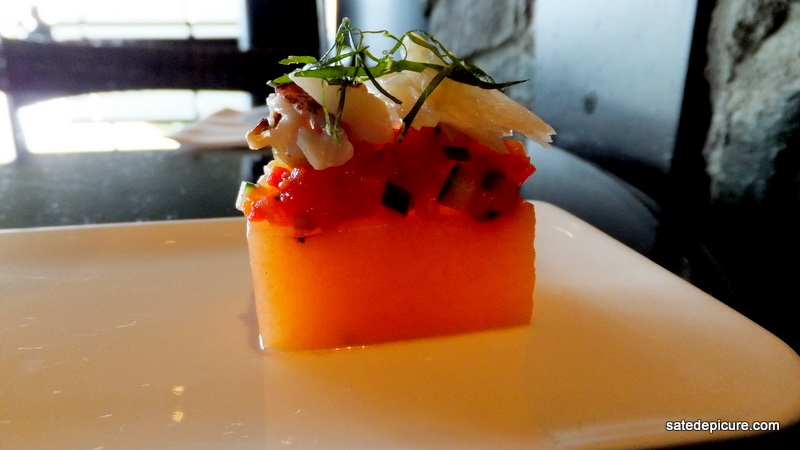
Amuse Bouche: Melon and Dungeness Crab


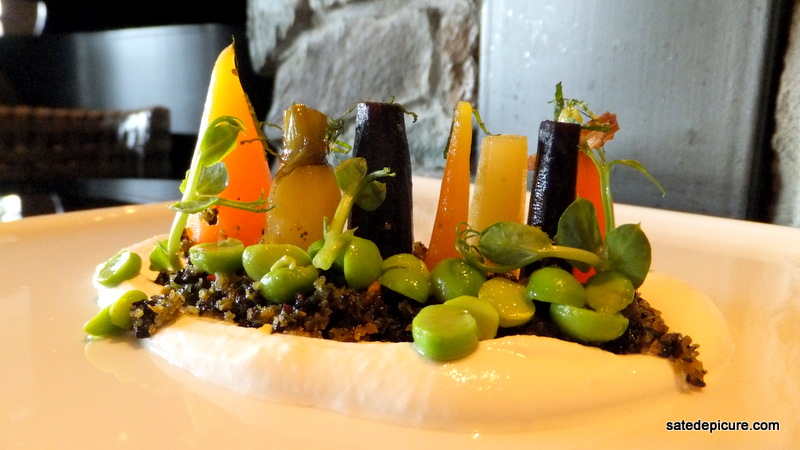
Peas and Carrots, Farm fresh goat cheese and a morel mushroom crumble

Duck Egg Slow poached with asparagus, watercress, and uni


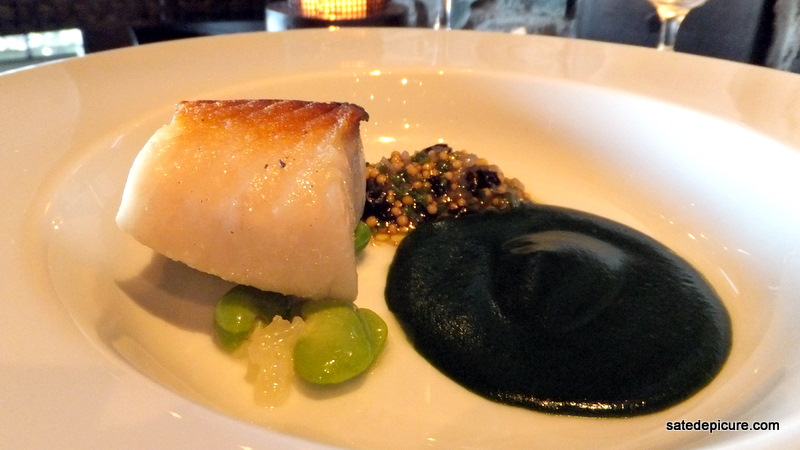
Black Cod Pan seared, with fava beans, nettles, and fermented black garlic

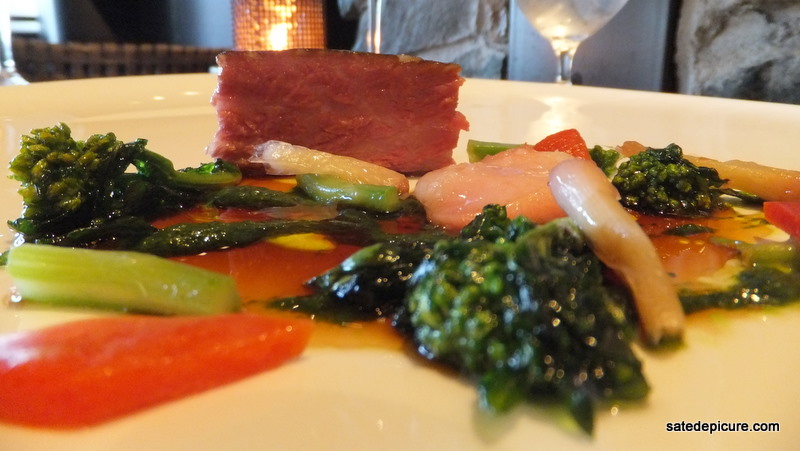
 Short Rib Braised for 48 hours, with ramps, broccoli rabe, and smoked bone marrow

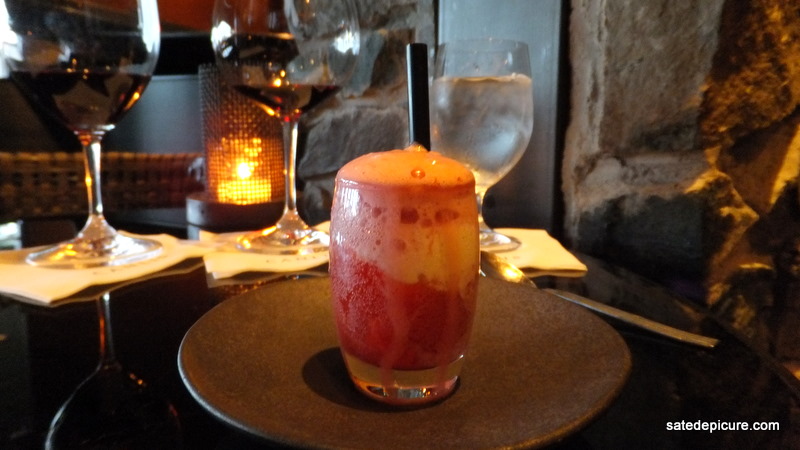
Strawberry Fizz

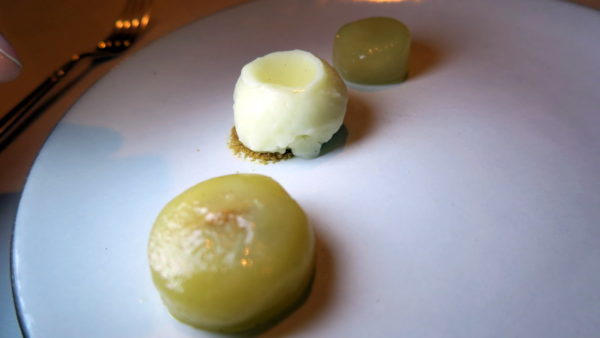
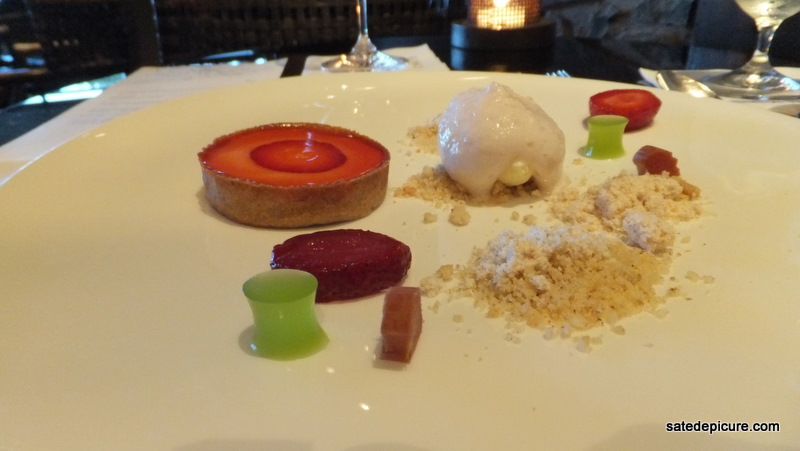
Rhubarb Tart Strawberries, fennel ice cream, and Champagne espuma

Canlis Restaurant, Est. 1950

2576 Aurora Avenue North   •  Seattle, Washington 98109

www.canlis.com

Menton Restaurant, Boston

Posted 01 Jun 2011 — by S.E.
Category Fine Dining

I love the city of Boston for many reasons. It’s a large American city with a great skyline, tremendous history (by American standards), an active cultural scene, great architecture, the best academic institutions in the world, and fantastic people. The city also has the highest proportion of female celebrity chefs in the country and that in itself is worth celebrating.  Barbara Lynch is one of those chefs.

Lynch is incredibly smart. Just over a year ago she chose to locate Menton, her latest fine dining outpost, in the rising Fort Point neighborhood of Boston. Menton occupies the first and lower floors of the FP3 building, an old brick mill building that has undergone a thoughtful adaptive reuse under the watchful eye of Hacin + Associates architectural design and Berkeley Investments. Berkeley started the project during the dark depths of the recession and recruited Lynch as an anchor tenant. Talk about doubling down when times are tough! I love this kind of visionary thinking.

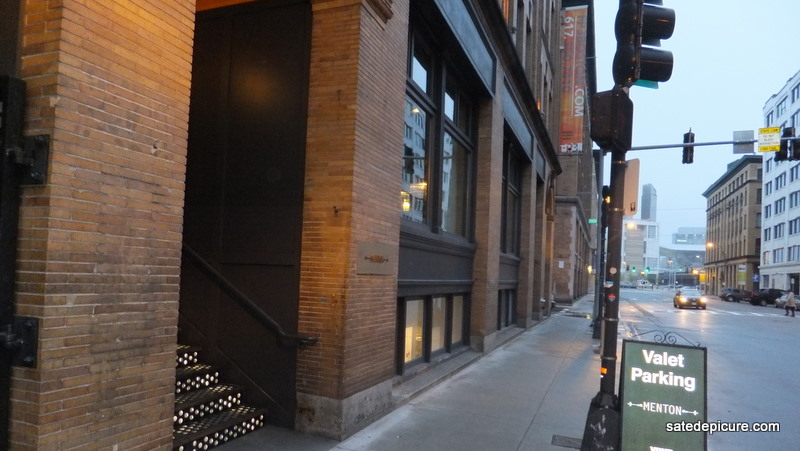
Menton is within walking distance to the Seaport district, Boston Convention center and surrounding hotels and other major new construction projects coming out of the ground in that part of the city. The location is easy to find although parking is tough and valet is a must. The restaurant entrance is completely understated with nothing but a small brass sign bolted to the side of the building marking its presence. I initially failed to notice the restaurant but spied the valet in front just as I was passing. Traffic on this side of the city is light so I spun around and handed over my keys. Just 15 minutes from Logan via the Ted Williams tunnel, I strategize timing for a quick multicourse menu prior to making a run to the airport.

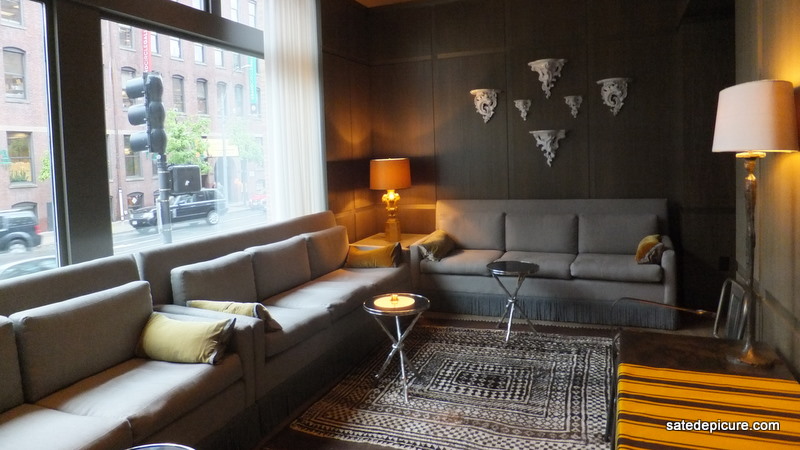
The color palette inside the entrance and sitting area is awash with gray upholstered furniture, rich brown paneling, mustard colored throw pillows and tall table lamps. Entering the dining room, the mood and design shifts to a stark and contemporary yet softer feel.  Each place is set with a service plate, napkin, knife, fork, water and wine glass and candle. Tablecloths are seamless and pressed and servers are formal. The building and environment have a central European chic with a truly local feel as does the food.

And the food starts to arrive. Each dish is carefully prepared but not overly fussy. Flavors are bold and well executed and portion sizes are balance and precise. Foods are locally sourced and perfectly cooked. Seasonal flairs flourish on each plate and I find the culinary aesthetic balanced and well controlled. The food is delicious.


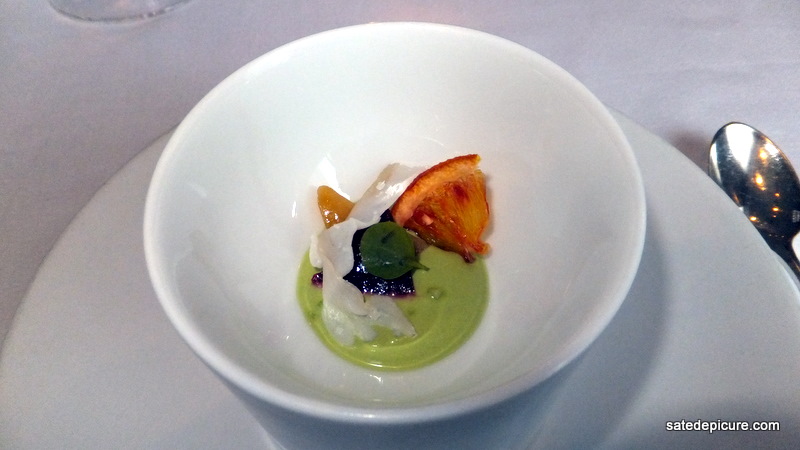
Amuse of Tarragon Puree, Porchetta, Crispy Mandarin Orange, Red Beets

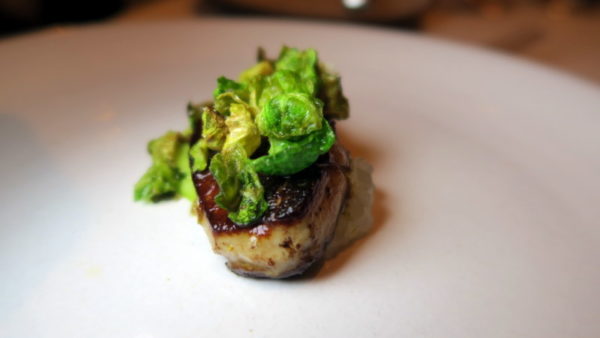
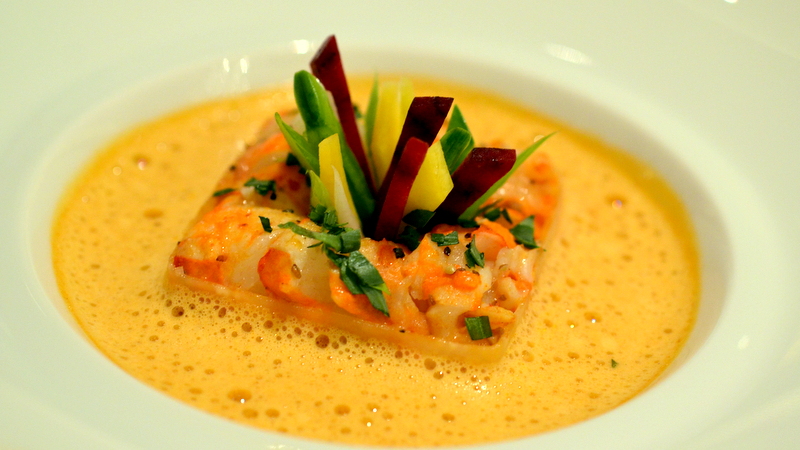
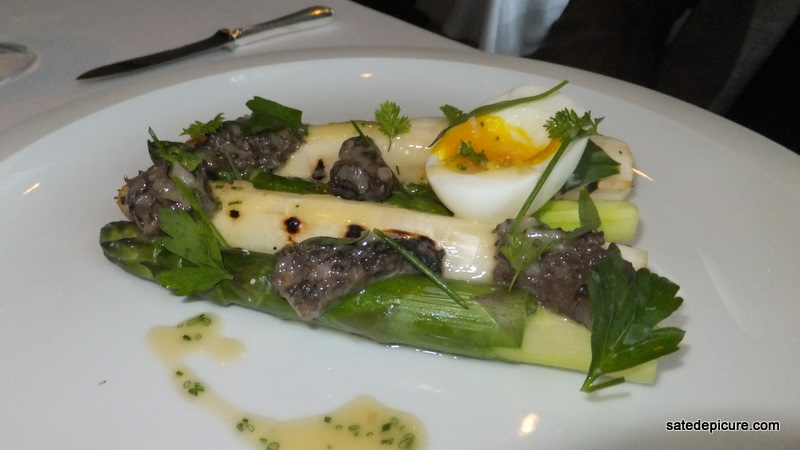
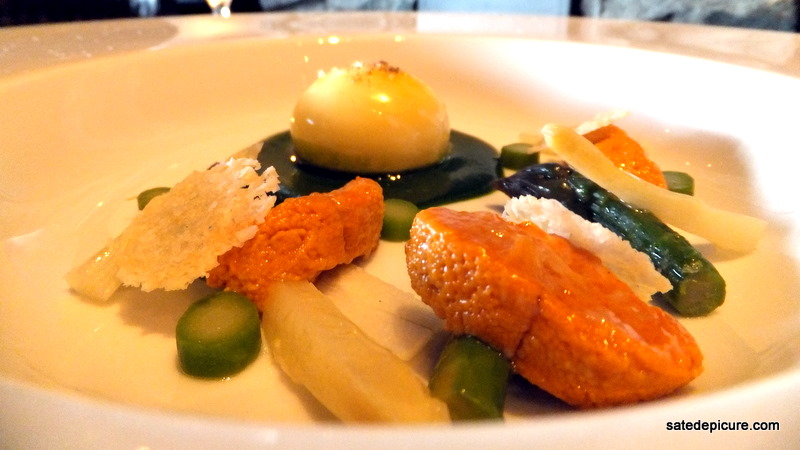
Green and White Asparagus, Araucana Egg, Morel, Fines Herbes

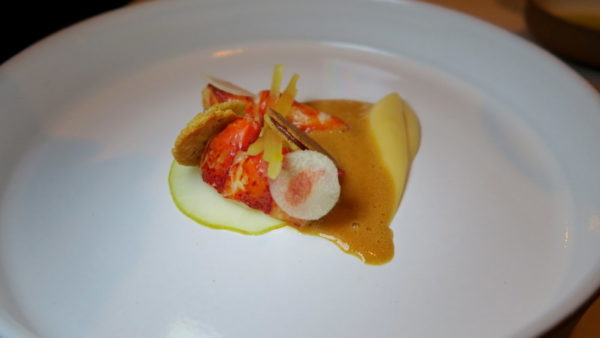
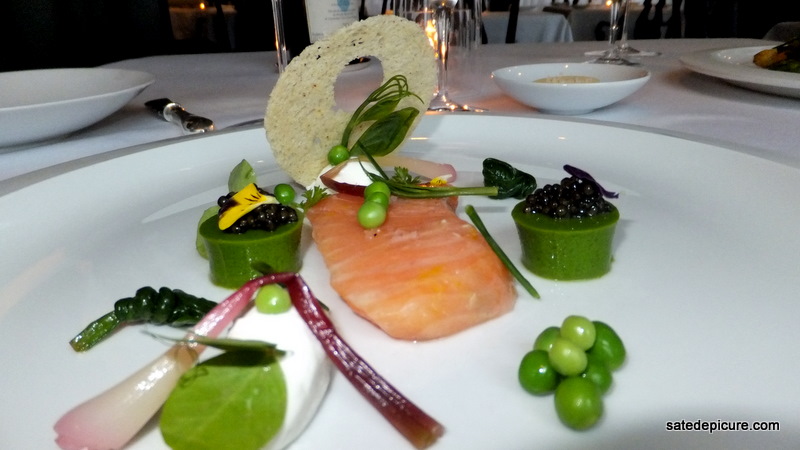
Salmon with Spring Peas, Ramps, Caviar

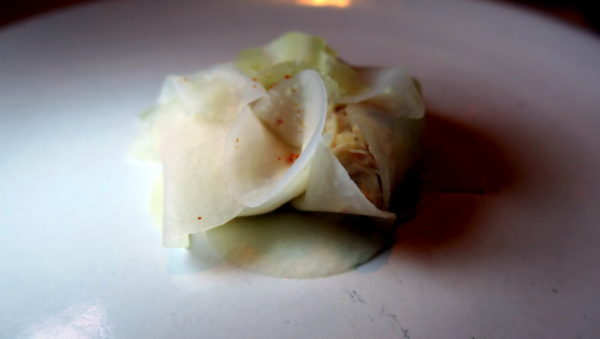
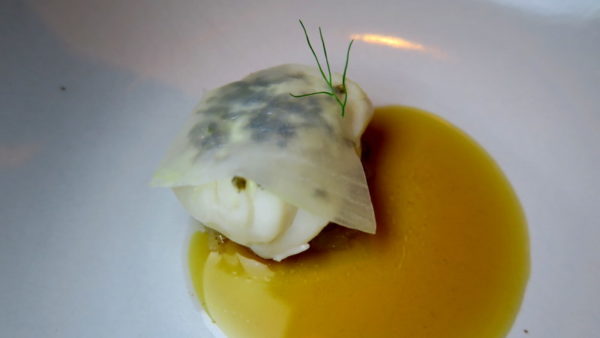
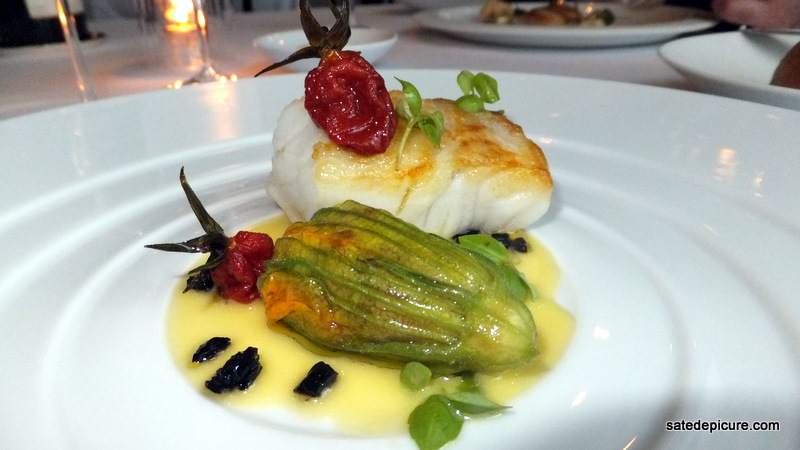
Casco Bay Codfish with Stuffed Squash Blossom

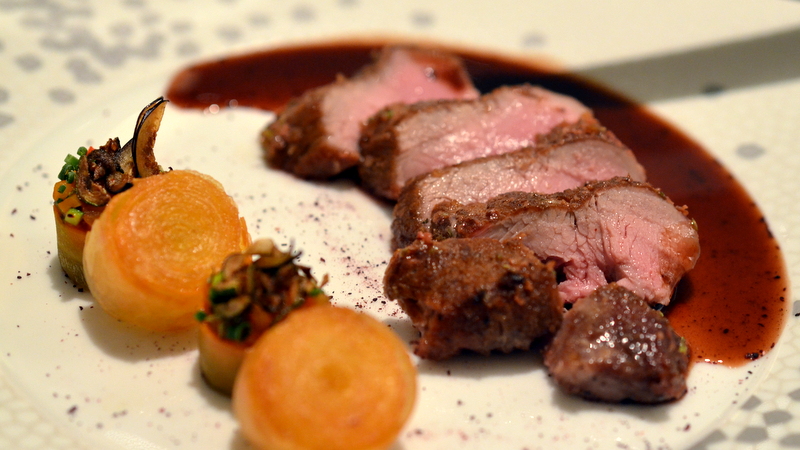
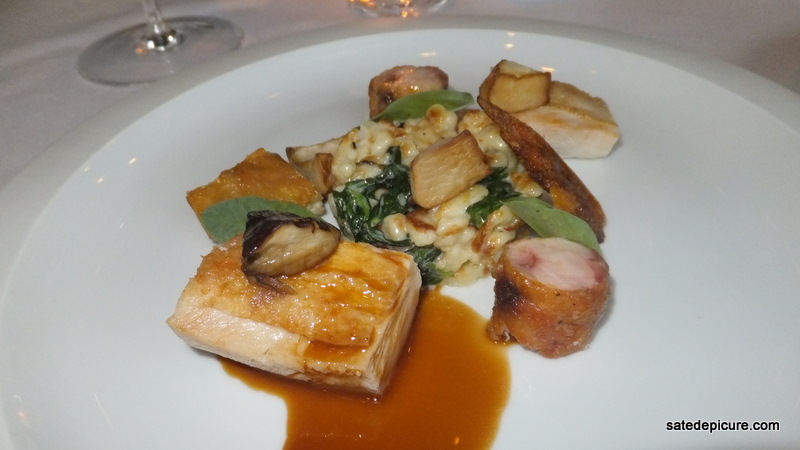
Giannone Farm Poulet, Porcini, Fava Leaf, Spaetzle


MENTON

354 Congress Street
Boston, MA 02210-1295
(617) 737-0099

Mother’s Restaurant New Orleans

Posted 19 Apr 2011 — by S.E.
Category Warms My Heart

It’s the middle of April, the bulbs in my garden are blooming and for some reason I am craving a taste of real Louisiana gumbo (don’t ask why). Ever since learning to make gumbo from a group of culinary friends from Louisiana back in the early 1990’s I have experienced periodic cycles of intense interest in this dish and tonight my mind and memory wander to the most recent gumbo event in my life: a steaming cup at Mother’s restaurant in New Orleans.

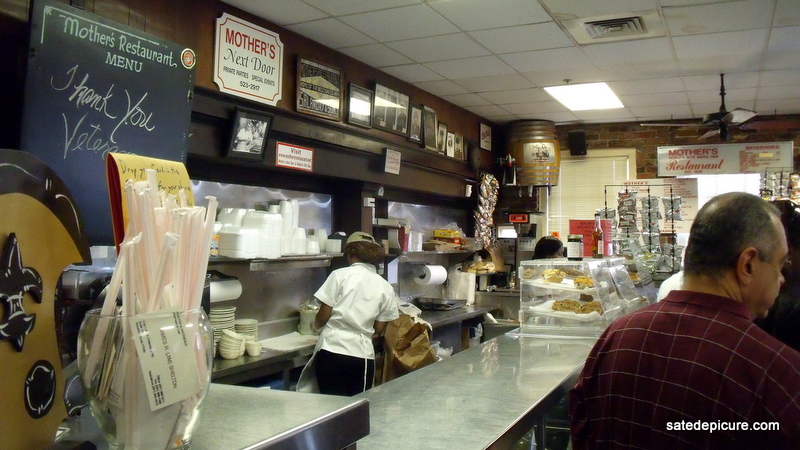
Mother’s Kitchen Counter

In 1994 Chef John Folse took me to Mother’s restaurant for the very first time. I was visiting John up in Baton Rouge for a week and he decided it was time for a quick run to New Orleans for a meal. We sped down the highway from Baton Rouge to the city in his big bad-ass BMW 5 series talking about food the entire way (his license plate reads “ICOOK4U”). He described Mothers with a religious style of reverence and it wasn’t long before I realized that he was taking me there to introduce me to the food and to fulfill his own craving for gumbo (John is a gumbo addict too). Since then I have craved Mothers from time to time and always make a trip there when in New Orleans. Some folks claim the food was better prior to Hurricane Katrina and others say Mother’s quality is as good as ever.

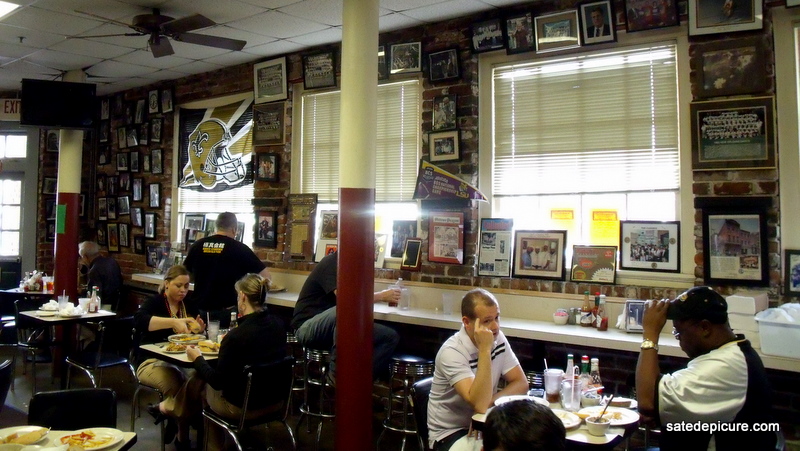
Fancy Dining Room

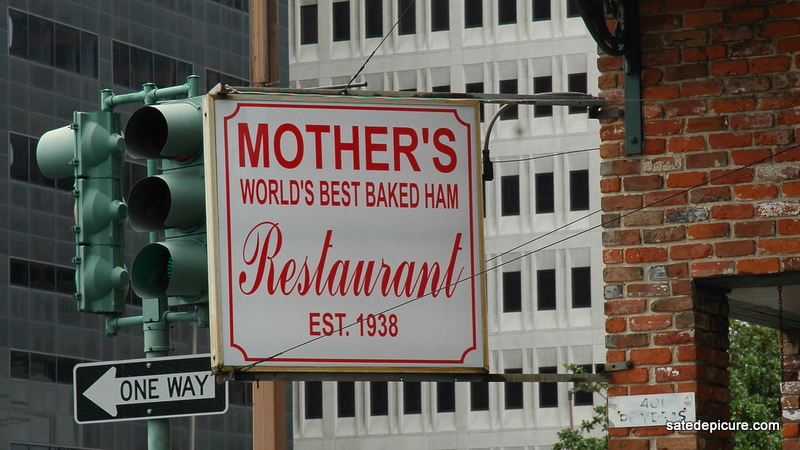
Established in 1938, the sign out front reads “Mother’s world’s best baked ham”. Who the hell eats ham when visiting mothers (they sell 175,000 pounds of ham and beef each year)? It’s funny how things evolve. Anyway, I arrive at Mother’s and, as usual, there’s a line out the door and it’s raining. The line moves quickly and I am inside within 5 minutes. The interior of Mother’s is decorated with all sorts of ephemera like old photos of guests from the 1950’s. Lots of pictures of soldiers and military veterans line the walls along with intermittent photos of celebrities and sports figures, many eating at a table in the restaurant. Tables are Formica topped and the chairs are metal with vinyl padding. The restaurant is not fancy nor is the food.

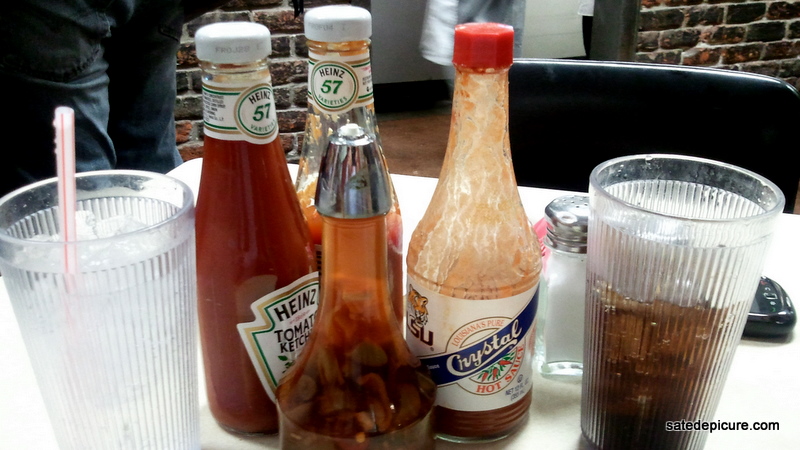
Condiments and Coke

Customers cue up along a metal counter adjacent to the kitchen and place their order at a cash register at the end of the line. While waiting, you can watch menu items being prepared right in front of you and I am sure cuing the line along the kitchen counter was intentional as a way of increasing sales. Once the order is placed, you take your ticket and sit down and wait. It takes about ten minutes to receive your food. My server was an older gentleman with a classic New Orleans drawl and heart of hospitality. He was fantastic and provided a real sense of the city in his service. My order: Shrimp PoBoy, cup of gumbo and a scoop of potato salad. Craving satisfied.


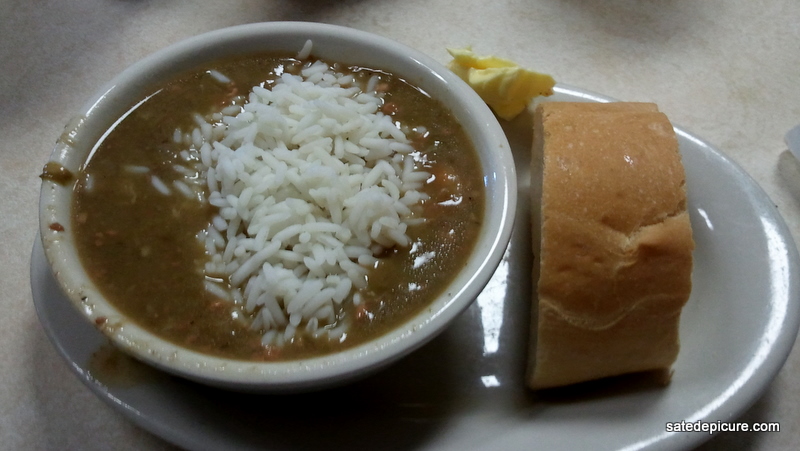
Seafood Gumbo: The real deal with a nice dark roux, rich fresh seafood flavor and sausage punch


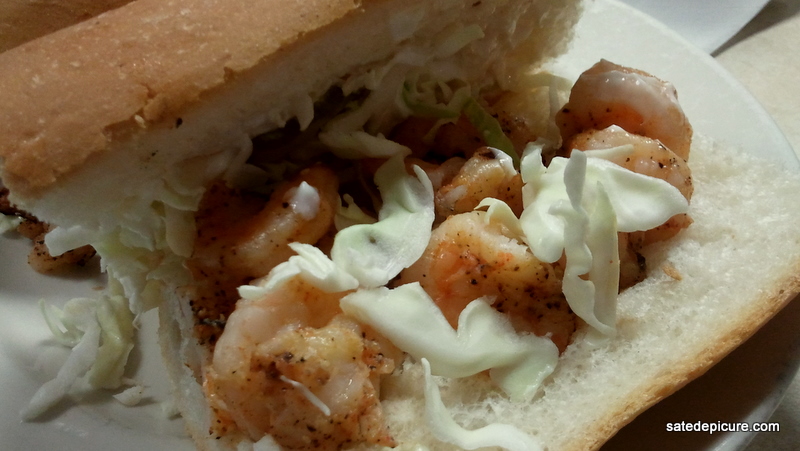
Shrimp PoBoy: Fresh shrimp, shredded lettuce, mayo


Mother’s Restaurant

401 Poydras

New Orleans, LA 70130

504) 523-9656

Alinea Restaurant: Reflecting on Excellence

Posted 21 Feb 2011 — by S.E.
Category Fine Dining

Table Top

Reading Christopher Borelli’s March 15th story about Chef Grant Achatz in the Chicago Tribune last week motivated me to finish up this posting about my first trip to Alinea. Borelli’s story piqued my interest and left me emotionally mixed due to the subtle rancor it exposed between Achatz and Chef Charlie Trotter, a rancor that has existed for years. Those of you who read this blog know that I admire Charlie Trotter and consider him a friend. He has made an indelible mark on American cuisine and, to my dismay is occasionally vilified for his intense personality and leadership style. It seems at times that people fail to notice his incredible heart and his enduring commitment and contributions to the profession. We are all fickle at times.

Achatz, on the other hand, is a true inspiration. I know him by two degrees of separation through a very good friend who worked as poissonnier at the French Laundry when Achatz was the chef de cuisine there and through several others who have stagieired with him. Achatz’s reputation is stellar and those that have worked for him stay in contact and consider him a friend. They speak of him with deep admiration of an authentic and heartwarming kind. That Achatz earned three Michelin stars delights me; that Trotter did not is saddening. In all forms of art there is a natural passing of the guard as generations shift, new talent emerges, and earlier icons transition to the background. In such a physically demanding profession, this is the cycle of life. Examples from the profession are too numerous to mention. I know Trotter could achieve 3 stars if he chooses, he and his team have the talent, drive, and resources. Time will tell.

Rather than see this cycle of change as unnatural or competitive like a foot race where a younger culinary runner outstrips an older runner who used to run a four minute mile, I see it as a relay race where Trotter burned a lap or two at his peak and has now handed the baton, begrudgingly, to Achatz. Someday Achatz will go through the same cycle and relinquish the baton to another younger culinary runner. Alinea is the restaurant in Chicago right now, one of the top 5 in the country, and Grant’s legacy is assured. However, Trotter’s legacy will remain intact too even as Achatz takes the lead role. Had Michelin come through in the 1990’s or early 2000’s, Trotter would have three stars. These are the mixed feelings that come to mind as I write of my delightful experience at Alinea; one that is on par and compares with my first trip to Charlie Trotter’s way back in the early 1990’s.

Alinea

It’s cold and dark and I think my cab driver is lost on the north side of Chicago. The address we are searching for is on North Halstead and that’s where we are, heading north but we can’t find our destination. We are desperately scanning the rows of brownstones for 1723 North Halstead home of Grant Achatz’s Alinea. I know we are in the right place but there’s nothing but row houses along the street. Its 9:20PM and my reservation is for 9:30. I am starting to get pissed, concerned that the cab driver took me to the wrong location. I wonder if I should get out of the cab and walk a while, but the street is deserted and I worry I won’t be able to find another cab if I am in the wrong place and have to back-track. The driver pulls over and we try to figure things out.

That’s when we see a bunch of people congregating around the entry of a two story loft like building made of grey brick and glass. It has to be Alinea. There is no big sign, no flashing lights or anything else. You arrive at Alinea when you find it. A stark contrast to the press and hype that Chef Achatz has endured these past five years, his name in lights everywhere but here. I pay and tip the cab driver feeling apologetic for assuming he was at fault and make my way across the street relieved to be on time and feeling excited.

In the dining room now, I am greeted and escorted directly to my table, a stark square table with a dark wooden top. The dining room is modern, equally as stark and comfortably spaced. Sitting alone for a bit I check out the service ware, glassware is Spiegelau, china is Bernadaud or custom made (as I will soon find out). Scanning the room while I wait, there are two waist-high buffets pushed up against a wall with white cloth tops, the servers using them as side stations. I continue to wait. The sound of a barely audible acoustic guitar floats from the sound system in the background. I unwind and relax. This environment feels cool and relaxing in a minimalist, Zen-like way.

Finally my server approaches, introduces himself and asks if I am planning to have the 12 or 22 course menu. This is an interesting question and one that I didn’t expect considering the fact that I wasn’t provided with a menu yet. Intuition firing, it becomes clear that the rules at Alinea are different so I ask how things work. My server educates me. The rules of the game require that I order from either the 12 course or 22 course menu. The menus are prix fixe and “engineered” for maximum flavor, balance, and creativity but can be adjusted for food allergies (not any) and dietary restrictions (none, thank you). Other than that, you are along for the ride and eat what you get. And this is where things get interesting. My meal was breathtaking and full of surprises and emotions unlike any other I have had before. Here’s a recap.
Seafood

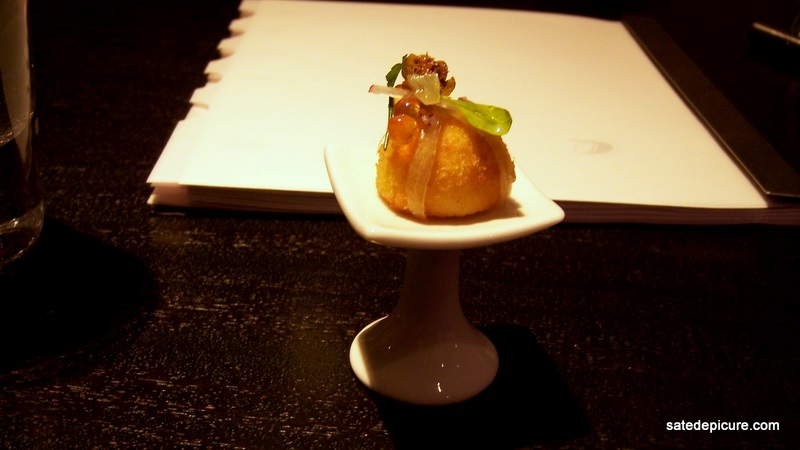
Croquette of Steelhead Roe with Parisienne of Cucumber, Sour Cream with Endive, Fried Caper and Steelhead Roe.

The little white ceramic pedestal this dish is served on intrigues me. That it is piping hot in the middle with so many tiny little garnishes blows my mind. Achatz’s mise en place must be pristine.
Seafood 

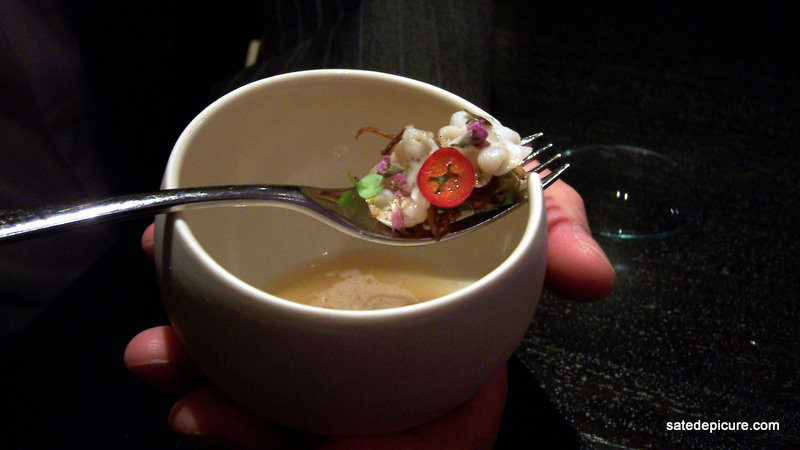
Lightly Grilled baby Octopus with Shiso and Broth

Another complicated dish with another twist added, the server hands you the bowl and warns not to put it down. Once you have the bowl in your hand, you must engage this dish and eat it. To keep things simple, a fork full of octopus is balanced on the edge of the bowl and ready for consumption. A quick bite off the fork and a couple of sips of the broth and it’s done. Servers rush in to take the bowl before it rolls across the table.
Mushrooms

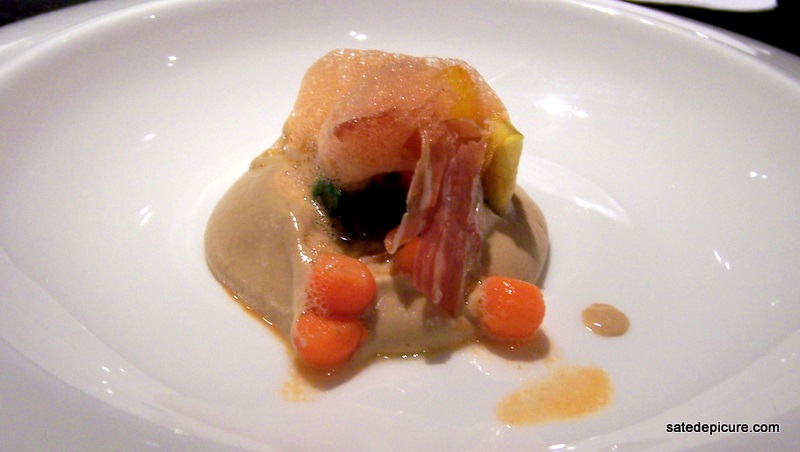
Golden Chanterelle Puree with Curry, Spinach, Dijon, Tomato and Apricot, Cured Ham, Carrot Foam

I have to admit that the thought of curry, apricot and Dijon didn’t initially appeal to me but once I tasted this dish I loved it. The deep savory mushroom puree with its silky texture served as a perfect base for the additional garnish and none of the garnishes were lost in this dish. Each brought its own notes of complimentary texture and flavor.
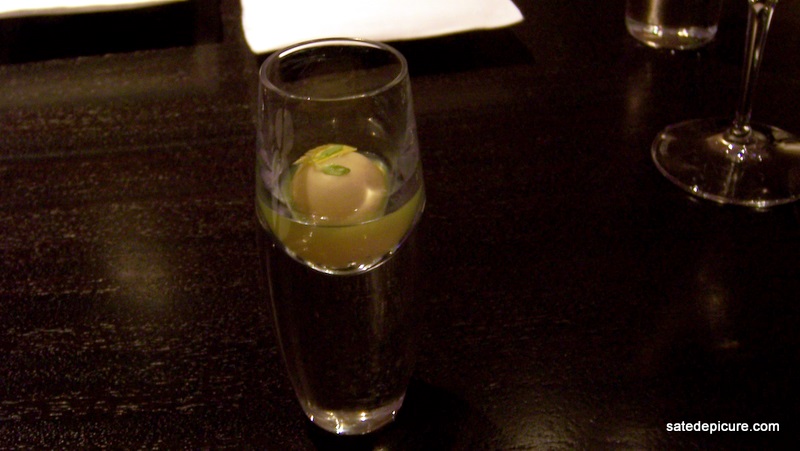
 

Celery Water and Apple Juice inside a Coco butter shell, Micro Celery Fronds

When the server places a top-heavy crystal clear shot glass with a tiny white ball and some green liquid in front of me, I am once again intrigued. The server warns to suck this item down like a shooter and to keep my mouth shut once I have the ball in my mouth to prevent it from exploding out across the table. In it goes…and wham…there’s an explosion. The cocoa butter ball totally bursts open upon impact and melts in milliseconds on contact with my tongue. The apple juice is tart and washes it down leaving a perfectly clean palate. Just incredible.
Seafood     

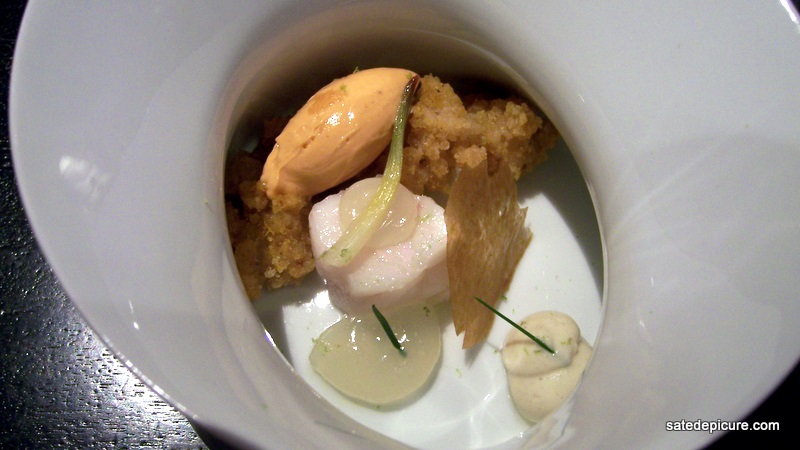
Monkfish Loin Fillet and Liver Quenelle with Banana Lime Pudding, Crispy Monkfish Tail, Dehydrated Onion Paper, Chive and Snowy Ramp

This dish is served in a lovely Luna plate is by “O” and it looks a bit like a commode. The presentation is striking if not subdued. Although a contrast in flavors that are rich and lean, savory, sweet, and acidic, this dish is also a real treat in contrast including smooth (quenelle), creamy (pudding), toothsome (loin), and crisp (tail and onion).
Duck

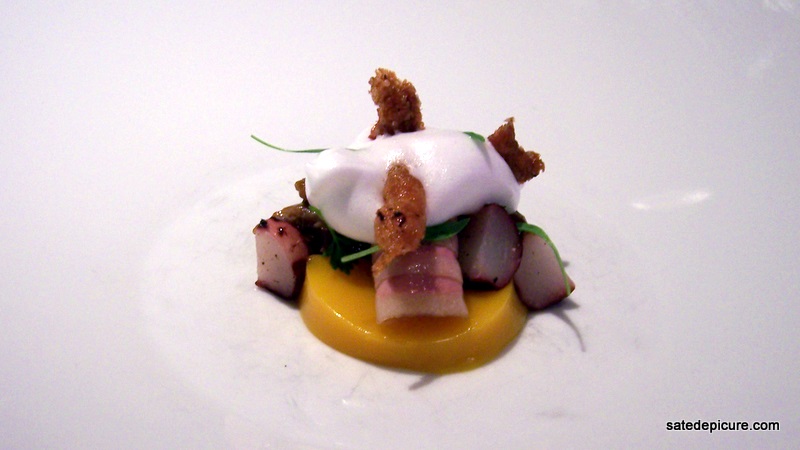
Juniper Duck 3 Ways with Wine Braised Turnips, Duck Leg Confit, Sliced Cured Duck Breast, Duck Craklings, Whipped Yogurt Water and Mango

My server places a pillow in a white linen cover in front of me of me and I don’t know whether to take a nap or use it as a napkin. A moment later the same server returns with my duck dish and places it on the pillow and the pillow immediately begins to deflate letting out a gentle bursts of juniper “air” that engulf my face. Inhaling the juniper, my mouth waters and I dig into the duck. Some real thought had to go into this dish, the flavor profiles engineered into it, and the theatrics that surround it. The overall experience is stunning.
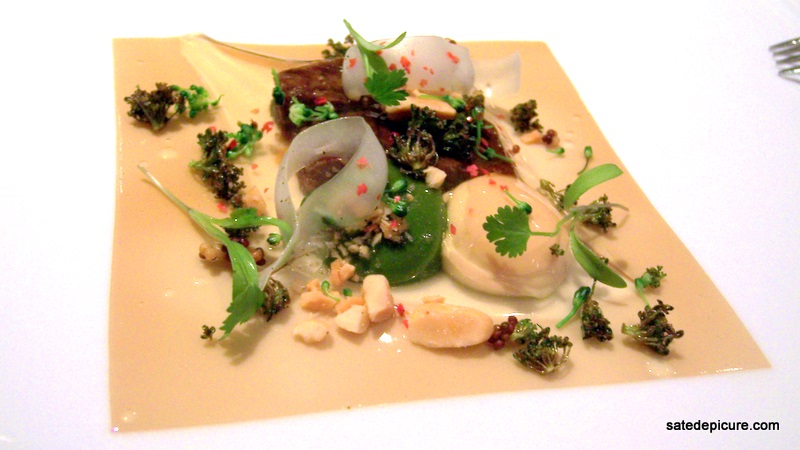
 Short Ribs

Cayenne Short Ribs with Guinness Gelée, Toasted Peanut, Peanut Puree, Broccoli Puree, Shaved Broccoli Stems, Crispy Broccoli Florets

Just when I think there are no surprises left, Achatz’s serves this piping hot short rib with a thin sheet of gelée over it. It looks like he shrink-wrapped the plate prior to sending it out to me. The gelée is suctioned to the short ribs and pureed garnish below it. Additional garnish are placed on top of the gelée providing a wonderful texture and contrast to the items pressed below. Aesthetically, this is the most profound course yet. That Achatz would think to create a thin sheet of gelée with the perfect level of bloom so that it stays intact over hot food but still melts effortlessly on the palate and then execute it so flawlessly speaks to his craftsmanship and creativity. The dish is absolutely delicious.
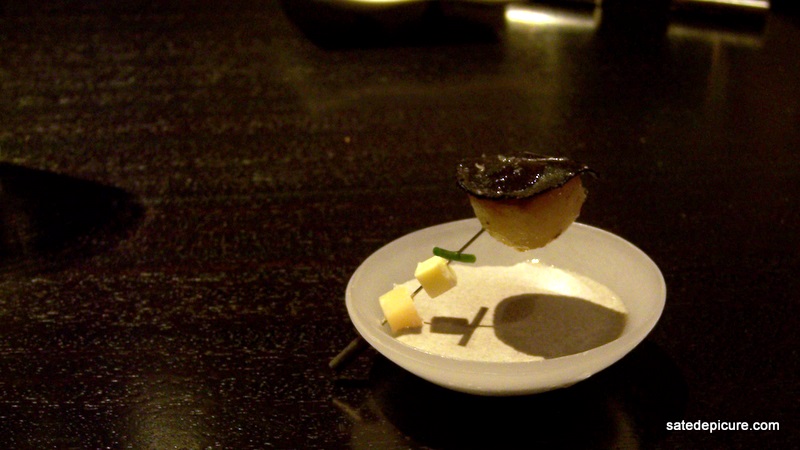
 Potato and Truffle

Potatoes and Truffle

This simple bite-sized item is a study in simplicity, the wax bowl seeming to me to be a bit of a novelty. Great tasting and the truffle is bold and full flavored.
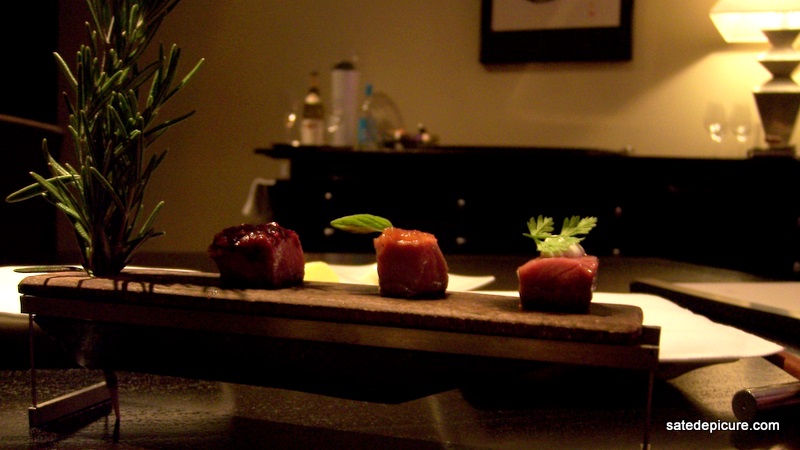
 Lamb

Lamb Loin Three Ways

Three square pieces of lamb arrive at the table on a sizzling hot rectangular stone mounted on a custom metal frame. At one end of the stone, there’s a bunch of rosemary propped up vertically through a hole. My server lights the tips of the rosemary and they smolder for a second or two, the scent of deep toasted pine lingering over the table. I consume this dish using chopsticks, each chunk of tender sous-vide lamb going down in one bite. The toasted rosemary is a nice touch.
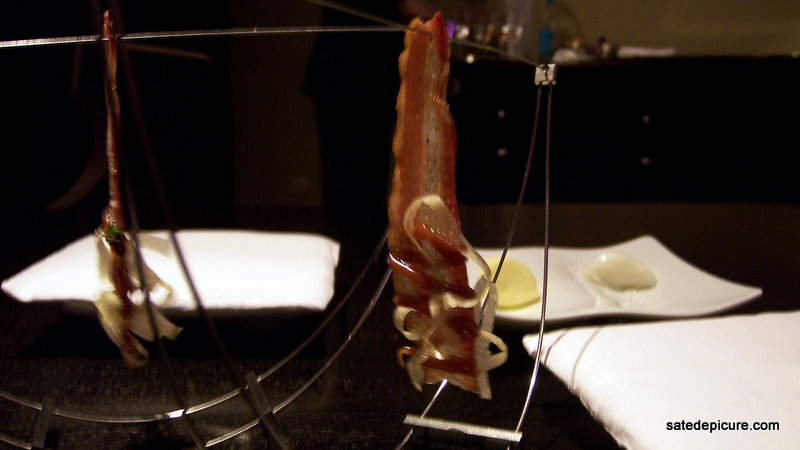
 Bacon

Bacon

Anyone who serves bacon as a course unto itself is a hero in my mind. Achatz’s fresh bacon is creatively served on a wire frame and is delicious and mild.
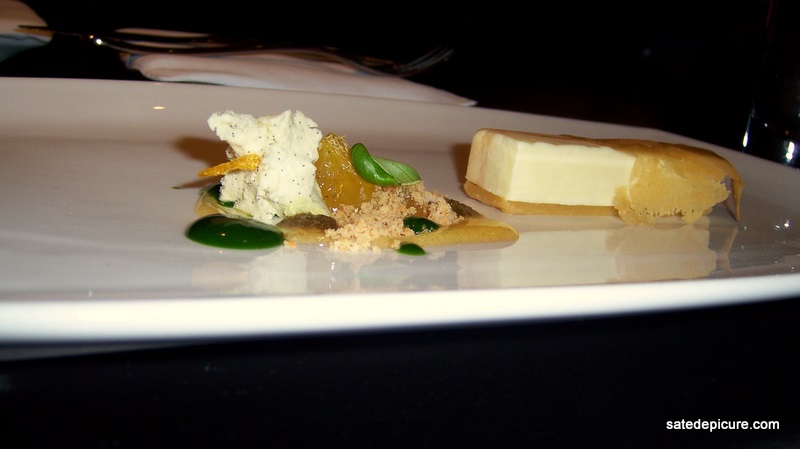
Ice Cream

Extra Virgin Olive Oil Ice Cream

The olive oil ice cream is smooth and delicious and the pressed cookie base under the pavee is fantastic.
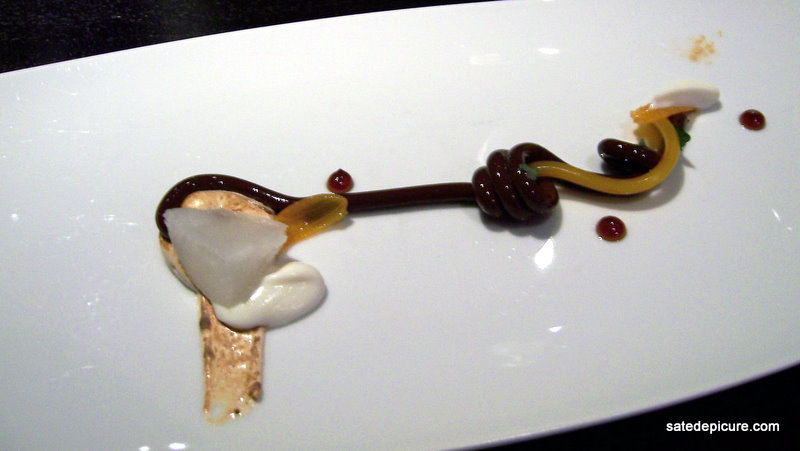
 Dessert

Chocolate and Passion Fruit Noodles

These hydrocolloid noodles represent a molecular technique that I like but feel is a bit over-done. Luckily they taste great; the chocolate is deep and slightly malted and the passion fruit a nice end-of-meal palate cleanser.

~~~~~

This is a long entry and one I have been meaning to post for some time. This meal was an adventure. When I started my meal without a menu my curiosity was peaked and each dish thereafter exceeded my expectations, entertained me, was innovative, delicious, and engineered on multiple sensory levels. There was more than a light dose of theater in my experience: exploding apple, puffing pillow, burning rosemary and all. Alinea is a national treasure and a place that, in my mind, defines one of the many facets of American fine dining in the new millennium. Achatz deserves three Michelin stars for taking the experience of dining to a whole new level. May he run the fastest lap yet during his time on the track.

Alinea

1723 North Halsted St

Chicago, IL 60614
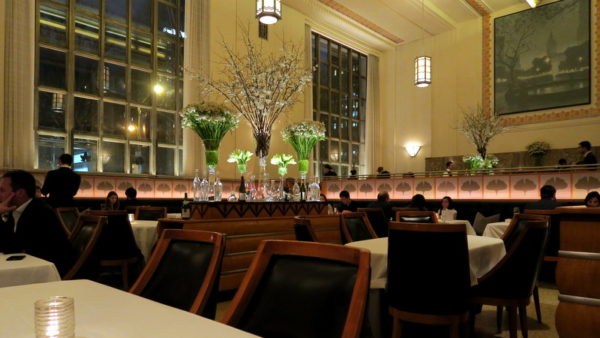
Roy’s Restaurant at Spanish Bay Resort: Pebble Beach, CA

Posted 08 Dec 2010 — by S.E.
Category Fine Dining, Full Service, Hotels

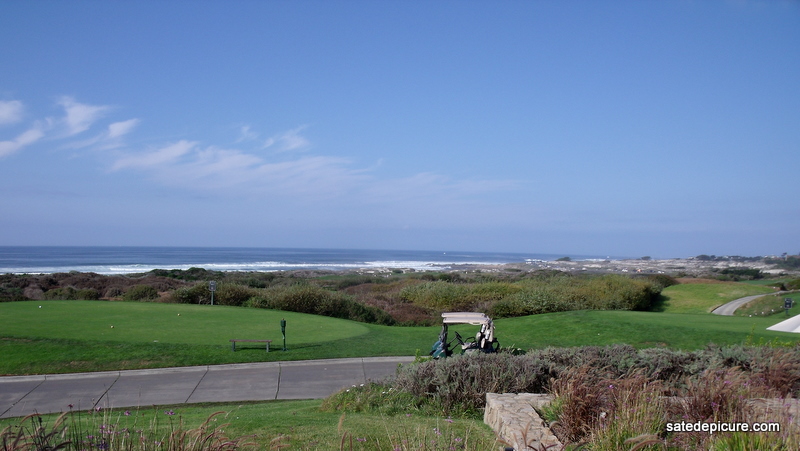
My exploration of Pebble Beach California had to include a trip to Roy’s restaurant over at the Inn at Spanish Bay Resort. More than one foodservice insider told me that this Roy’s outlet, one of 29 Roy’s restaurants located in seven states (Arizona, California, Florida, Hawaii, Illinois, Maryland, Nevada), operated by famed chef Roy Yamaguchi is the best of all and that Mexican born Chef de Cuisine Pablo Mellin is one of Yamaguchi’s more talented leaders.  After a wonderful long weekend in a rainy Pebble Beach volunteering for a local non-profit, the weather brightened up and I set out for Spanish Bay for dinner.  There is nothing like the drive south from Monterey along Forest Lake road to Seventeen Mile Drive. Once you pass the guard shack into Pebble Beach proper the world changes and a feeling of wealth and privilege pervades everything. The community is made up of homes belonging to the rich and, in many cases, the famous. The setting is absolutely amazing and fitting for The Inn at Spanish Bay, a resort that in early 2010 made the Conde Nast Traveler Gold List of the world’s best places to stay.

We pull up to the resort in our rental car, a nice Dodge Charger, and pass the keys on to the valet.  Sitting in front, parked for all to see is a spanking new Bentley GT convertible. Although some think it’s kitschy to display cars like this in front of a hotel or restaurant, I love it; it sets a tone for the clientele and suggests that the place is special.  After all, we are at Pebble Beach. Just the night before I was in this same hotel and passed Tom Brokaw walking down the hall and said hello. I recognized his nasally voice while walking past and then had to step aside for Leon Panetta (a resident of Pebble Beach from what I hear) and his Central Intelligence Agency entourage (black Chevy Suburban SUV’s at the front door and all) as they made their way to their vehicles parked at the entrance.  Spanish Bay is other-worldly and so are the clients that visit here.

As we exit our car and head toward the resort’s front entrance, I notice a gentle but comforting heat radiating down from the warmers located in the porte-cochere ceiling above us. By the time we arrived  the weather had cooled and this little bit of gentle warmth was a nice touch. Looking around the entrance, the building was well lit with large exterior windows and high quality architectural design.  All of the sidewalks and exterior grounds were spotless and perfectly kept down to each blade of grass.  The doorman held the door for the ladies, welcomed us warmly and, more important, genuinely as we entered. It was a wonderful first impression, just the kind of attention to detail that is becoming rare in this economy as we value engineer the finer details out of commercial life.

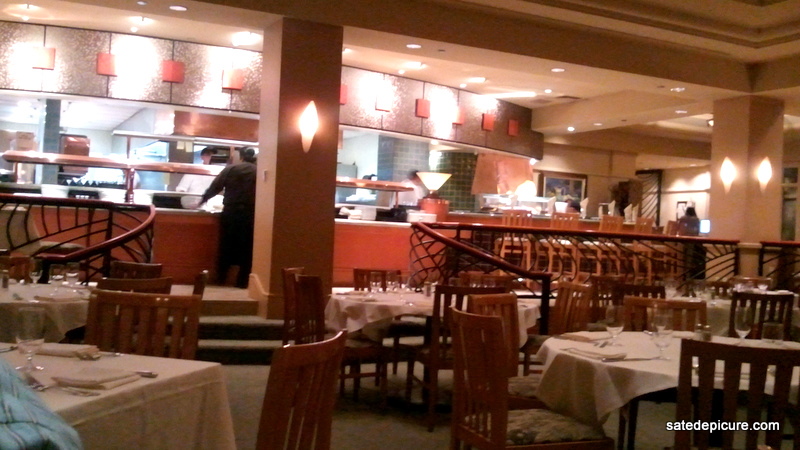
Roy’s Restaurant Dining Room

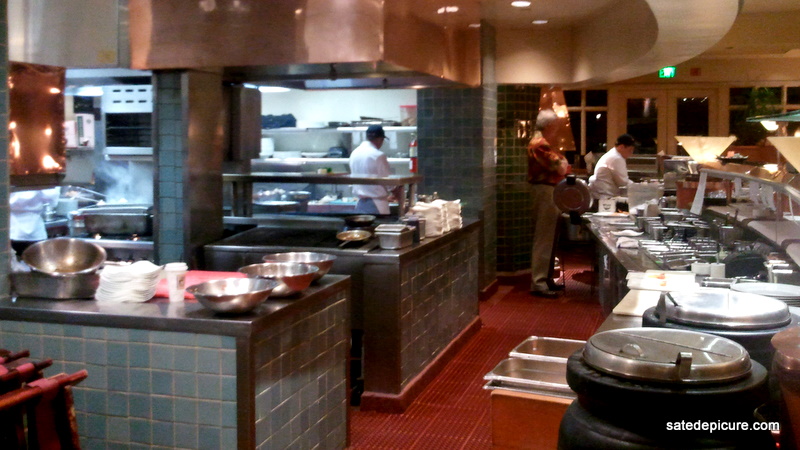
Once inside Spanish Bay, finding Roy’s is a straight forward task. You take a quick left, then a right and pass the main lobby and the large bar and sitting area and proceed toward the back of the room until you come to a maitre d’ station at the entrance to the restaurant. On the other side of the restaurant’s entrance the room opens up to a multi-level modern space with a huge open kitchen and a large dining room with well over 150 seats. Roy’s isn’t small and, when busy, the kitchen probably runs fast like a locomotive.  When we arrive its early (6:00PM) and the room is only half full.

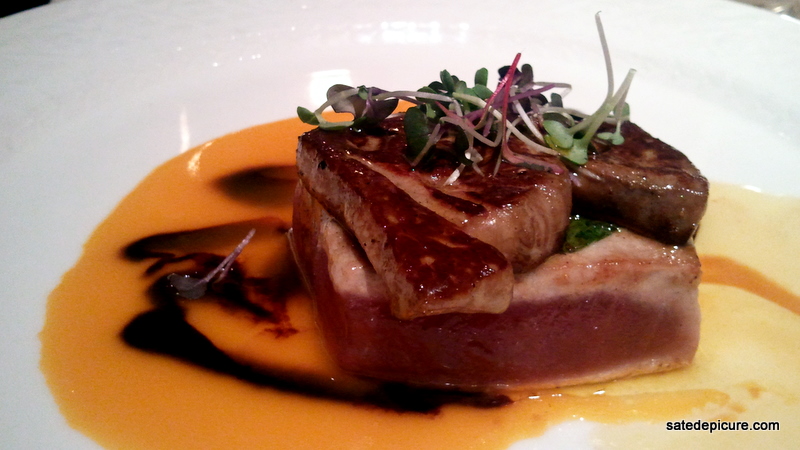
Foie Gras Mochi $16.50


I am with a group of three other individuals and we quickly decide to share four or five items from the menu and place our order within minutes. Service is prompt if not a bit slow but this often is the case when a restaurant is running half full. Experience tells me that the best time to be in a restaurant, contrary to intuition, is when it is running full speed. Don’t misinterpret, full speed means running at capacity not running over capacity. Restaurants hit a tipping point when more than ten percent of dining room capacity is pushing to get a table. They also hit a point of declining return when service is running at half speed. Give me a full restaurant with well managed table turns and no line at the door any day of the week. Roy’s service was running slow but, luckily, the food didn’t reflect this at all. Roy’s is also just one culinary cog among many wheels that spin and make Spanish Bay the multi-million dollar resort that it is.

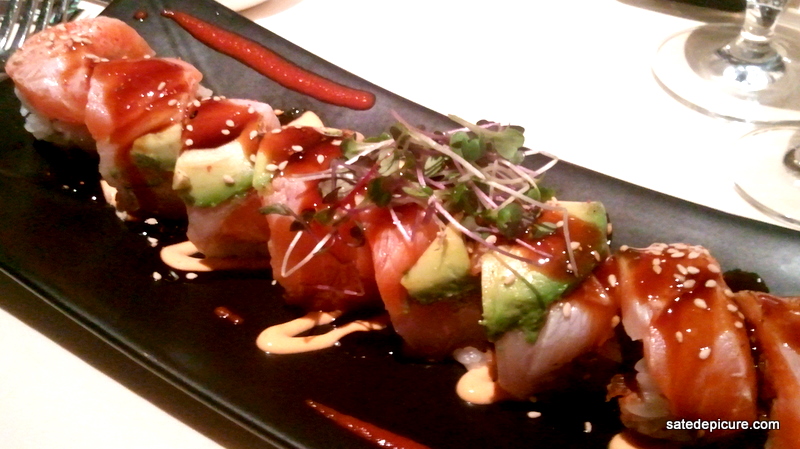
Spanish Bay Sunset Roll $19.75

While at Spanish Bay I had the chance to tour the back of the house including the main banquet kitchen, pastry kitchen, the conference rooms and banquet dining rooms; all of them wheels that spin to make Spanish Bay what it is. The restaurant outlets, including Roy’s, share a common purchasing, facilities,  operations, and human resource departments. I met Chef Mellin while taking my tour and talked with him for a minute or two. With jet black hair that’s tightly cropped on the side, neatly trimmed mustache and huge smile, he is an affable, friendly, and passionate culinary leader. I was inspired to see one of our Mexican colleagues, a key hardworking group in American foodservice that often gets overlooked, finding such success and it was clear as Mellin made his way through the property that he was highly respected by his peers.  We need more of this in foodservice!

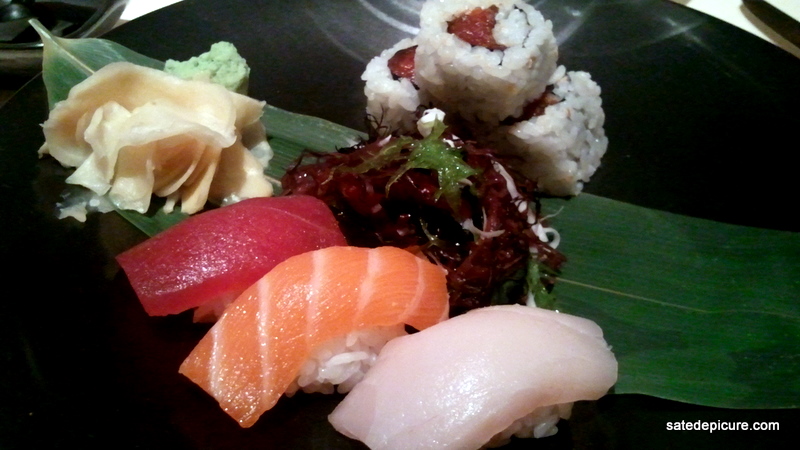
Our food arrives and we dig in. The first dish I taste is the Foie Gras Mochi with a healthy slab of seared foie gras sitting on a seared pave’ of tuna. I have had this combination before and it is a match made in heaven.  My next taste is a sampling of sushi (maki and nigiri) with one piece each of Tuna, Salmon, and Yellow Tail and three pieces of spicy tuna roll with seaweed salad. My colleague orders the Spanish Bay Sunset Roll composed of spicy tuna and avocado and I taste a piece. Everything is at the peak of freshness, tastes great and is perfectly executed. Sushi is simple and varies little from place to place other than in the fine details like how the seafood is sliced and the quality and freshness of the ingredients. Mellin is using the best he can get his hands on and the quality we experience reflects this. We continue eating and try a couple other appetizer items and wrap up our dinner. The room is filling up now and the kitchen is starting to rock and roll as we head to the door.

Roy’s Kitchen

Spanish Bay is a beautiful property and may be the nicest of all the Pebble Beach resort properties. It’s well maintained public spaces, tremendous Spanish inspired design, and pristine golf course (some say the best at Pebble beach) creates a relaxing if not ultra high-end feel and Roy’s fits right into this setting serving  a super-fresh, light, Hawaiian Fusion cuisine. There are a few good restaurants in Monterey and some interesting places like Nepenthe further south in Big Sur but Roy’s could be the leading restaurant in this stretch of California coastline (I will let you be the judge).

Roy’s

Inn at Spanish Bay

2700 Seventeen Mile Drive

Pebble Beach, CA 93953

831-647-7500

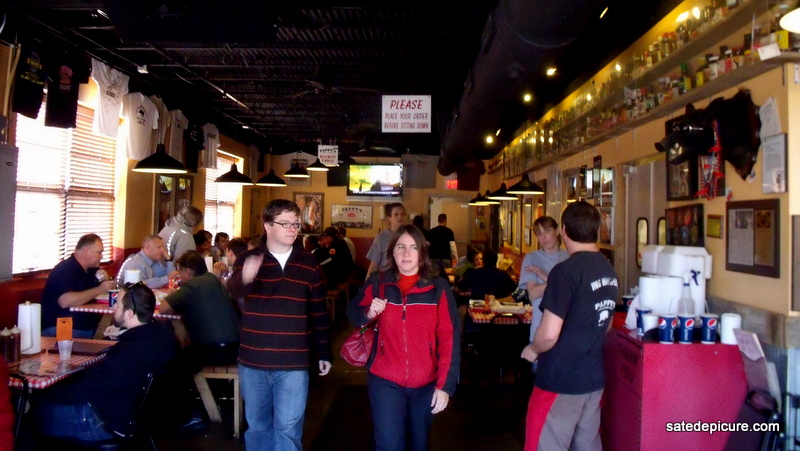
Pappy’s Smokehouse, St. Louis, MO

Posted 05 Dec 2010 — by S.E.
Category Quick Service

St. Louis Missouri is a special city. It’s a city with a fresh and interesting restaurant scene and deep hospitality streak running right through it. I had no idea how vibrant the culinary scene was in St. Louis until I recently took the time to get out and see for myself. After a quick flight down from Chicago, hunger pangs were registering in my belly as I checked into my hotel. Room key in hand and bags in the room, I pulled out my handheld and launched Zagat’s NRU Android app, searching for a good place to eat lunch. Within a minute I found Pappy’s Smokehouse, cross checked it on Yelp to see what people were saying about it and headed down to the lobby and out the door.

With the St. Louis arch in view, I stepped out onto Chestnut Street and grabbed a cab. Riding through downtown St. Louis it became clear that the city had seen better days, been through some tough times, and is pushing to turn itself around. There were multiple buildings, small and large, that were empty or just partially occupied. At street level, I passed two stores within a half of a mile or each other dedicated to providing local consumers with pay-day loans and bail bonds; not a good sign. Yet, through the center of the city there’s a fantastic string of parks with extensive and diverse public art on display. We drove past Gateway Mall and its green space, Serra Sculpture Park, named for Richard Serra’s controversial series of steel sculptures (walls really), past Memorial Plaza and Aloe Plaza and the fantastic, water-spouting “Meeting of the Waters” sculpture by Carl Milles. St. Louis’ investment over the past century in this urban corridor of green space and diverse art exceeds that of many cities twice its size and the aesthetic the parks create is a positive yet sharp contrast to some of the areas immediately surrounding the city center. One block west of Aloe Plaza the last green patch of park serves as a home for hard-knocks daytime drinkers taking sips of booze from brown paper bags. Although threadbare in spots, the city is vibrant in others and, like many American cities on the mend; there are pockets of development that suggest a brighter future.

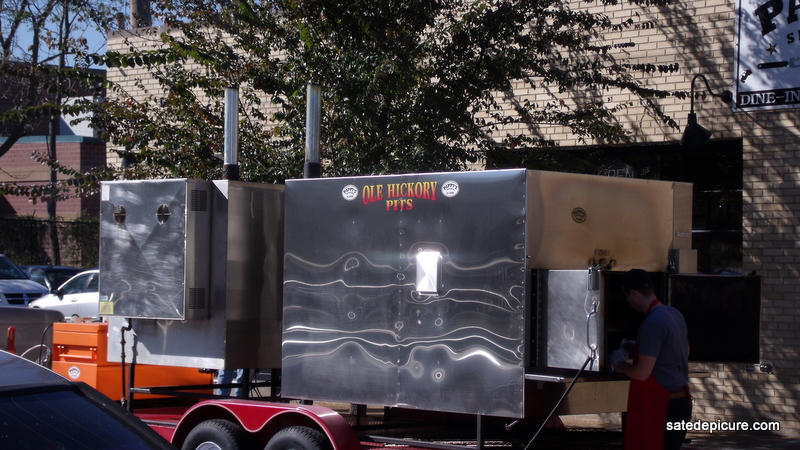
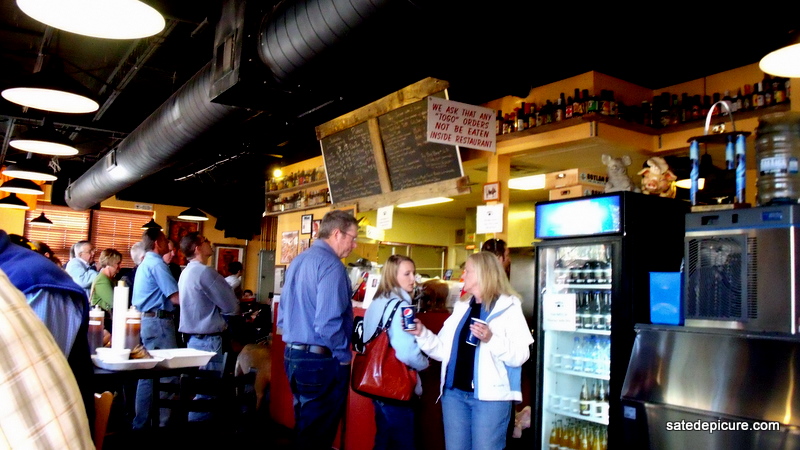
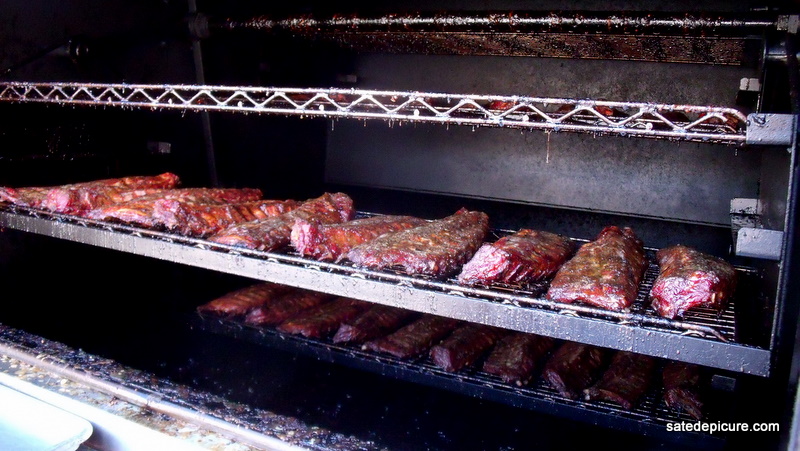
About a half mile past the city center Pappy’s appears on the left adjacent to Harris-Stowe State University. My cab pulls into the side street where the restaurant is located and I jump out and immediately smell hickory smoke and roasting meat. Crossing the street to the entrance, I encounter a red colored flat-bed trailer parked right in front of the restaurant with two “Ole Hickory” smokers chugging away. A chef is standing to the right of the front entrance talking with a guy with a graying goatee wearing a baseball hat, collared shirt, and jeans. Both look up as I approach, each appears in his mid 50’s. The guy in the chef coat heads over to the smoker parked in front while the guy in the baseball hat grabs the front door and pulls it open for me. I thank him and he smiles and asks how I am doing. We start a conversation and I explain that I am visiting town, just landed a couple hours earlier and came to fill my belly. He smiles again, introduces himself and we head inside. By pure coincidence, the first person I meet at Pappy’s Smokehouse is Mike “Smokey” Emerson, founder and owner extraordinaire. By the time I explain who I am; Mike has been joined by “Skip” Steele his executive chef. Skips shakes my hand, comments how lucky I am to arrive when there are only 10 people in line and he suggests I get in line fast and place my order. I take his advice and join the cue.

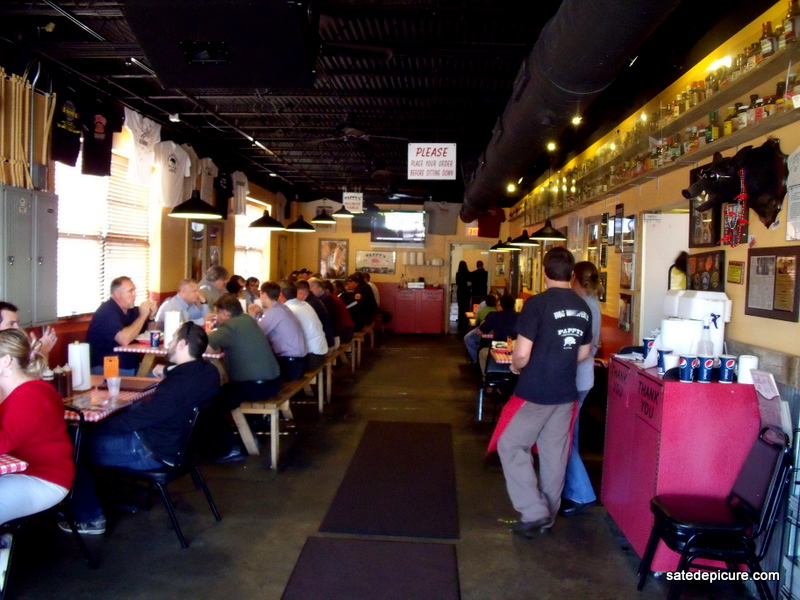
Before a minute passes, Smokey Emerson is back with a hot smoked pork rib for me to sample. I take a bite and the meat gently falls from the bone into my mouth. The full flavored, moist, savory and mildly spicy rib is fantastic. My mouth is full as I grin with approval at Smokey.  Arriving at the counter to order I notice how simple the set up is. There are two cash registers sitting on a counter next to each other just inside a large window into the kitchen. Two menu boards hang on the wall above the cash registers.

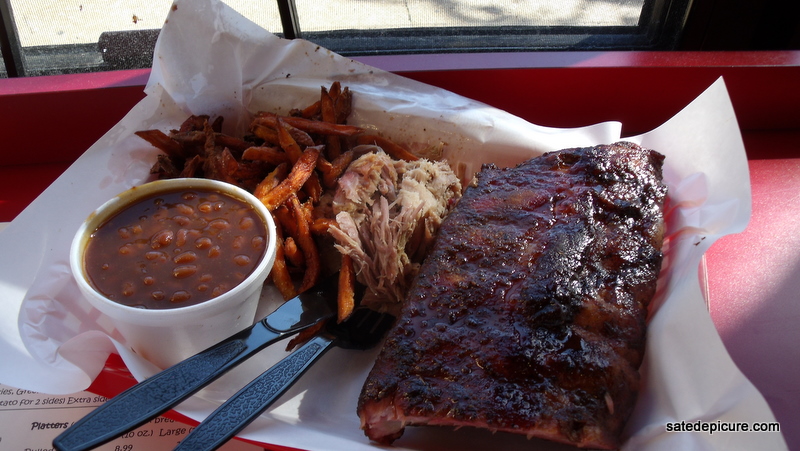
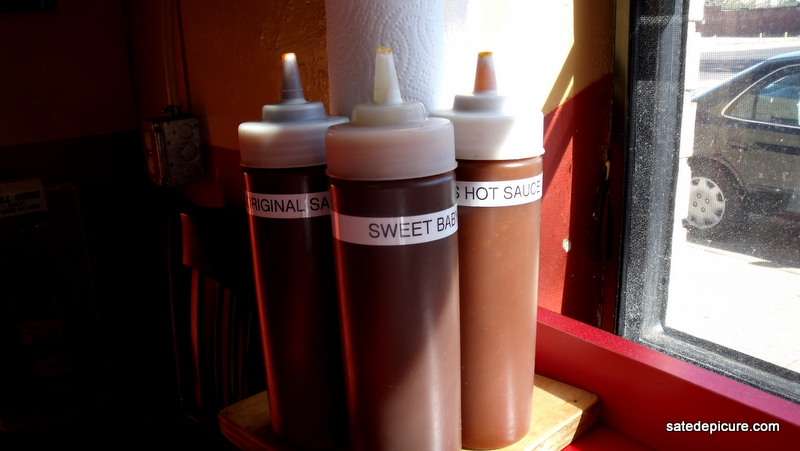
I order a half-rack of ribs, pulled pork, baked beans and sweet potato fries. The cashier directs me to a seat and informs me that my order will be delivered shortly. By the time I get to a barstool along the bay window adjacent to the cashiers station my order arrives in a plastic basket lined with parchment paper. A nice seven-rib rack sits on one side, the fries and beans in a three ounce Styrofoam cup on the other, and a four ounce portion of pulled pork in the middle. I dig into the pulled pork first, having already tasted the ribs. Steele’s pulled pork is perfectly cooked, tangy with just enough spice and salt and moist – just the way I like it. Pappy’s offers customers three homemade barbecue sauces; original, sweet, and spicy. I pump a few drops of Steele’s spicy barbecue sauce on the pork to see how it tastes and it’s fantastic. The beans are tasty and the fries are good but neither is the main attraction. Pappie’s is known for ribs and the ribs are the highlight of the meal. Moist and perfect, I consume half a rack in the blink of an eye. As I am wiping my face with a paper towel, Skip comes over and hands me a Styrofoam cup full of sliced beef brisket, another one of his specialties. The brisket melts in my mouth, is full of beef, smoke and spicy flavor.

While I eat, Skip tells me his story, how he was a chef working in Las Vegas, made his way east to get the “smoke out of his veins” found himself in St. Louis and connected with Emerson to put Pappy’s on the map. Steele has thirty years of culinary experience and the battle scars to prove it. After a few minutes we discover several common friends in the culinary profession and share stories about the good, the bad and the ugly of the foodservice world. As I finish eating he offers to take me to see the kitchen, a certain degree of mutual respect settling in as always when talking food with another industry veteran.

Entering the back kitchen I am stunned by how small the space is. One half of the room is filled by another Ole Hickory smoker. This one is named “Walter” and has a wooden sign above it with this name burned into it. To the right, there’s a large walk-in refrigerator with dozens of bins full of prep. Peering up along the aluminum flashing along the top of the exterior of the walk-in I notice a series of dates and times someone has recorded in sharpie pen. The dates and times start on the right and, for some odd reason, work their way to the left. Each date to the left posts an earlier time than before and I ask Skip what the dates and times represent. “That’s the record for how quickly we run out of food and close” he says.

Pappy’s makes a certain amount of food each day following a strict set of quality standards. Once the food runs out at Pappy’s Skip and Mike shut the restaurant down and head home. Reading the dates and times, it appears that every few weeks Pappy’s sets a new record for closing early. Rather than increase production and risk a decrease in quality, Mike and Skip take the high road and focus on the integrity of their food. I have tremendous respect for these guys.

We wrap up the tour and head to the front door so I can catch a cab back to the hotel. Thanking Skip and Mike for the experience, we exchange business cards and step out onto the sunny sidewalk together. I look to Mike and tell him that the level of hospitality, from the moment I entered until stepping back outside to leave, far exceeded my expectations. By now the line to order is pushing out the door. Mike smiles again and states that the level of hospitality I experienced is part of Pappy’s culture and something he and Skip work hard to protect. They have done a great job. Looking back, it was the hospitality that really made the difference at Pappy’s. Their food was excellent and the service was smooth, seamless, and perfectly natural not forced; a real example of elegant simplicity paired with authenticity. I like restaurants that are real!

Pappy’s Smokehouse

3106 Olive St.

Saint Louis, MO 63103-1213

314-535-4340

Butcher: Smart Casual in New Orleans

Posted 30 Nov 2010 — by S.E.
Category Food Alert Trends, Full Service, Uncategorized

Sometimes I stumble upon a great restaurant without intending to do so. This was the case recently when I wound up on a bar stool in Butcher, Chef Donald Link’s sibling restaurant to Cochon in the warehouse district of New Orleans. Butcher was not my destination, I had originally set out to find the National World War II museum on Magazine Street. After a couple of wrong turns I ended up in the vicinity of the museum but three blocks further west than intended.  Looping back around the block I wound up in a maze of one-way streets woven through warehouses, condos, and restaurants that make up this side of the city. Within minutes I was back at the corner of Tchoupitoulas Street and Andrew Higgins Drive where I originally started feeling frustrated.  Andrew Higgins was the founder of Higgins Industries in New Orleans during the 1920’s. His Higgins Boats, light military landing craft designed to deliver troops directly from ship to shore, are widely acclaimed as one of the crucial innovations that helped the allies win World War II. That I  am on Andrew Higgins Drive indicated that I was in the right vicinity and that it would make more sense to park the car and walk over to the museum than continue wandering.  Thats when I found Butcher.

Fate would have it that I parked the car diagonally across the street from Chef Donald Link’s famous Cochon restaurant. Approaching on foot curious and hungry for lunch it was disappointingly clear due to inactivity that the main restaurant was closed. However, there was activity further down the block at small shop called Butcher.  Although reasonably well informed when it comes to restaurants, I hadn’t heard of Butcher prior to spotting it up the street. The customers seated at each of the two small tables on the sidewalk and group of people standing just outside the entrance are what caught my eye, the entrance being otherwise pretty ordinary.  
Once inside my perspective completely changed.  Although small in size, the seating area in the café was packed and there was a line five deep at the counter. Butcher was humming and the food being served looked excellent.  Customers at Butcher cue up just inside the entry and place their orders at a counter with two cash registers at the back end of the shop. The lines form up against two massive refrigerated deli cases filled with homemade charcuterie and fresh meats on the left side of the room.  A small hot kitchen is just on the other side of the cases.
I am in line now staring into the first deli case on the left which is packed with a selection of sausages, bacon,  long brown links of house made Andouille sausage, packages of Boudin Sausage (four links per pack), fresh pork loin, skirt steak, and ribeye, even a Jambalaya stuffed fresh chicken.  The line moves and I shift forward several feet where there’s another case with gorgeous house-made Pork Rillettes, Duck Rillettes, Duck Terrine, head cheese, Mortadella, Salami Cotto, and Duck Pastrami. I am in hog (and duck) heaven. The quality and craftsmanship on display in these cases is outstanding bordering on inspirational. A fan of all things Garde Manger, my mouth is beginning to water.

The line moves forward again and now I am next to the small butcher block countertop that serves as the pass for plates coming off the hot line. Studying the kitchen for a moment I am quickly distracted by a plate of braised duck on cornbread with poached eggs and mushroom gravy that comes up off the line. It is absolutely gorgeous and a perfect brunch item. A server passes by grabbing the poached eggs and another couple of dishes, forces his way through the line and runs them to a table. Starving, my attention shifts to the three large menu boards hanging above the cash registers and I start to narrow down my order. There are too many interesting items on the menu for me to choose just one so I order a Cubano sandwich, a duck pastrami slider, and a pancetta mac and cheese. The cashier hands me a number and I turn back toward the seating area to the right of the cue to find a place to sit. Seats vacate just as I start to move away from the cashier and I grab a bar stool up against the wall and to wait for my order.

It’s just around noon time on a Sunday morning and Butcher is packed with a mixed bag of late morning revelers, brunch seekers, and folks that strolled over from local residences. Based on the steady stream of food coming off the hot-line it’s clear that these people know how to eat; smoked country sausage with two eggs, house-made biscuit and Steens syrup,  fried chicken and biscuit with caramelized onion and cheddar cheese, BLT of house made bacon, arugula, tomato, and onion. It feels good to be in this restaurant.

The sun is shining brightly through the south-facing storefront and a handsome couple enters and takes a small table up front next to the window.  Glancing over at the couple as they settle in, I consider how warm, pleasant, and comfortable this place is compared to what it must have been like just after hurricane Katrina. Donald Link opened Cochon in 2006 after six months of delays due to the hurricane. In early 2009 Link added Bucher to his growing list of restaurants and the New York Times promptly dubbed it a “smart-casual” restaurant. I like the idea of a place being smart and casual.

Duck Pastrami Slider $6.00

My food arrives and I dig in. The mac and cheese is rich, creamy and full of savory richness from the pancetta. My Cubano is made with slow roasted pork loin (cochon du lait), smoked ham and cheese and grilled golden brown.  I splash a bit of Link’s sweet potato habanero sauce on one half of the sandwich and the sweet spicy flavor of the sauce adds a nice contrast. My favorite item however, is the Duck pastrami slider. A generous portion of sliced duck breast pastrami is grilled with cheese between two slices of bread until crispy and golden brown. By the time the plate gets to me, the cheese is just barely oozing out of the sandwich. It tastes delicious.

Pancetta Mac & Cheese $6.00

 I can only imagine the vision and perseverance required to withstand the challenges of Katrina and the BP oil spill in New Orleans. And yet the city lives on in places like Butcher due to people like Donald Link. Smart, casual, and sated…


Cochon Butcher

930 Tchoupitoulas St.

New Orleans, LA 70130

504-588-7675

Nepenthe Restaurant: Big Sur, California

Posted 24 Nov 2010 — by S.E.
Category Full Service

Our drive down the pacific coast highway from Monterey to Big Sur was hampered by a persistent rain. The road was slick and shrouded by patches of fog floating down from the hills to the ocean’s edge several hundred feet below.  Although hoping for a clear view and some speed on the road, we took it slow and saw little. For months I had been hearing about a restaurant called Nepenthe and the more I heard the more it appeared that the restaurant was one part natural wonder, one part spiritual oasis and one part commune for the Fassett family who own the property.  The rain provided a mysterious emotion to our drive to Nepenthe that was fitting as I soon realized when we arrived at the restaurant.

Nepenthe is located on a pitch hill in Big Sur in the middle of nowhere, the only culinary outpost of its kind for miles to the north or south on scenic highway one. We pulled into the dirt driveway at 11:45 in the morning and the parking lot was deserted and strewn with puddles of rainwater. From the parking lot, you can’t really see the restaurant perched on the hill above but the size of the parking lot and the double wide stairway leading up suggests a facility of substance. We started our climb in a light drizzle through a lush dripping canopy of redwood and oak trees with trunks painted with patches of bright green fuzzy clumps of moss.  Halfway up the stairs to the restaurant on a concrete platform there’s a red enclosed phone booth, sliding door and all, tucked in the corner with a wooden park bench next to it. The evocative British feel of the phone booth paired with the rain, gloomy canopy of trees, fog, moss and prevailing grey cloud cover left me feeling like I was headed to the London docks in winter at sundown.

Ascending the final flight of stairs we arrived at an expanse of red-painted concrete that serves as an outdoor patio and seating area in better weather. The patio was slick with rain and long rubber mats leading to the restaurants entrance were laid out to assure secure footing. Even shrouded in fog the setting is astounding. The sound of waves crashing below whisper up revealing just how cantilevered the setting is on ocean’s edge.  Curious, I sneak away for a moment and peer through the trees to see if I can spot the ocean below. For a brief moment the cloud cover breaks in some places and bits of sunshine illuminate patches of the seashore and the foaming greenish blue ocean. Time stands still.

I wander further from my group down another flight of stairs to Nepenthe’s funky Phoenix gift shop. Surrounded by bohemian splendor, I find myself out on the back deck staring at large terracotta shards of Buddha’s face laying along the slope, a small bust perched on the adjoining stone wall. The rain is falling harder and a strong ocean breeze is rushing up the slope forcing the rain to fall horizontally into my face, the wind chimes on the patio all ringing in unison. My clothes are starting to soak through so I head up to the restaurant.

Back inside they have a large fire going. It is warm, dry, and comfortable. Legend has it that Lolly and Bill Fassett along with their five children bought the location back in 1947 from Rita Hayworth and Orson Welles.  The Fassett’s worked with architect Rowan Maiden, an apprentice to Frank Lloyd Wright, to design their vision taking full advantage of local red wood trees to frame out the two story post and beam interior. When you arrive at the center of the dining room, massive rough hewn redwood beams are assembled like Lincoln logs above allowing a long row of floor to ceiling windows along the entire south side of the room facing the ocean.  We work our way past the main dining room to a cozy smaller room to the left with a large banquette and small fireplace.

We place our orders and I have the signature Ambrosia Burger, a six ounce burger that is grilled and served on a toasted soft steak roll topped with Ambrosia sauce (mayonnaise, tomato sauce, mild chile salsa). I have a side of bean salad and order my burger with lettuce and tomatoes. From where I am sitting I have a view over my right shoulder into the Nepenthe kitchen just on the other side of the knee wall that makes up the back of the booth side of the banquette. The kitchen is open to the vast dining room, is spotless and running quiet. We are one of two tables seated and our food comes out in short order. My burger is perfectly cooked and tastes fantastic. Nepenthe has Carmel Meats and Specialty Foods in Marina, CA custom grind its beef daily and you can tell when you taste it. The bean salad is tangy and well seasoned too. To finish things off I have a cappuccino and a slice of homemade banana cream pie.

Everything I taste is delicious if not overly simple. Looking the menu over, there are few items that are complicated and the prices are reasonable when you consider the setting (the Ambrosia Burger is $14.00). By the time I finish eating the restaurant is nearly full with a lunch time rush.

 Reflecting back on my visit, Nepenthe is seventy percent location, setting, emotion, and aesthetic and thirty percent food and service. Menu items are reasonably priced but the view and setting comes at no extra cost and is worth a day’s wages let alone the $14-$37.00 entrée prices. My trip up the slippery winding stairway was worth every step, the meal worth every penny. The gift shop is funky and features something for everyone including the four Asian dolls picured below. Sometimes it’s more than the food that leaves me sated. The setting and the company I dined with at Nepenthe were spectacular and remind me why dining is one of lifes true pleasures.


Nepenthe

48510 Highway One, Big Sur, California

(831) 667-2345

Rasika ~ Washington, D.C. Indian Fine Dining

Posted 12 Oct 2010 — by S.E.
Category Fine Dining

Last month during one of my trips to Washington D.C., I made a point to trek over to Rasika at 633 D. St., NW in Penn quarter on for a meal. Being a fan and follower of great Indian food, I had been meaning to eat at Rasika for months but never had the time. This trip the timing worked so I made a reservation with high anticipation. What excites me most about Rasika is that it’s pushing the limit on Indian fine dining in America and earning rave reviews along the way including one of the highest scores for food in Washington D.C. by Zagat. Rasika also has talent in the kitchen. Executive chef Vikram Sunderam, one of the few Indian chefs to be nominated for a James Beard award (best chef Mid-Atlantic 2010), has a refined yet authentic touch when creating menu items and produces food as elegant as the stunning décor and service at Rasika. This is a serious Indian restaurant with a serious, talented, professional Indian chef.

Sunderam was hired away from the Bombay Brasserie in London by Rasika owner Ashok Bajaj. With Sunderam at the helm, Bajaj opened Rasika in 2006 to compliment his collection of restaurants in the Washington D.C. metro area. It’s telling that Bajaj had to recruit talent from London when opening Rasika. There’s no one else in America pushing the limits on Indian food the way Bajaj is at Rasika and, other than from India itself, London is the only place with an Indian culinary community mature enough to provide Rasika with this level of back-of-the-house talent. Reflecting on the restaurant décor, website, food, service and style, it is clear that Ashok Bajaj is a man of vision.

Bajaj’s first restaurant, Bombay Club, opened in 1989 and is now a Washington institution. After arriving in Washington in 1988, having completed stints with the Taj hotel group in India and London, Bajaj scraped together the resources to open Bombay Club with a partner and, sans partner, has added another restaurant to his empire every 2-4 years since. While dining at Rasika Bajaj stopped over to my table to say hello. He’s a distinguished looking, well dressed gentleman with great presence. He departed my table after a minute or two and I watched him walk away. As he walked he shifted his head from one side to the other, eyes darting around the restaurant to each table. Bajaj has the intuitive ability to “sense” when a restaurant is running well that all great restaurant owners have and his vision drives the progressive Indian fusion cuisine Rasika is known for.

Rasika represents the steady evolution of Indian cuisine in the U.S. Twenty years ago it wasn’t uncommon to find one or two good Indian restaurants in major cities but the cuisine was less prevalent in suburban areas and the food was tame compared to Indian food in the U.S. today. Even Bajaj agrees that the American dining public is shifting toward a wider acceptance of Indian cuisine. Perhaps we are headed into an era where Indian flavors and cooking techniques will become as common in America as Latin and Mediterranean flavors have been in recent years. If this happens, we will have Sunderam and Bajaj to thank, in part, for showing us the way.

My meal at Rasika was served family style for a table of seven. The photos below reflect this (FYI).  

Chili Garlic Scallops $12 Ginger, lemon juice, poha

Barbeque Shrimp ($12) Fresh mint chutney

Entrée (l-r) Bhindi Amchoor (sliced okra with dry mango powder), Dal Makhani (lentils, tomato, garlic, fenugreek), Chicken Tikka Masala, Basmati rice

Rasika Bread Basket $8 Assorted Naan/Roti

Gulab Jamun ($8) & Apple Jalebi Beignet with Cardamom Ice Cream ($8)

Rasika 633 D St. NW

Washington, DC 20004-2904

 202-637-1222